Currency
Toggle Nav

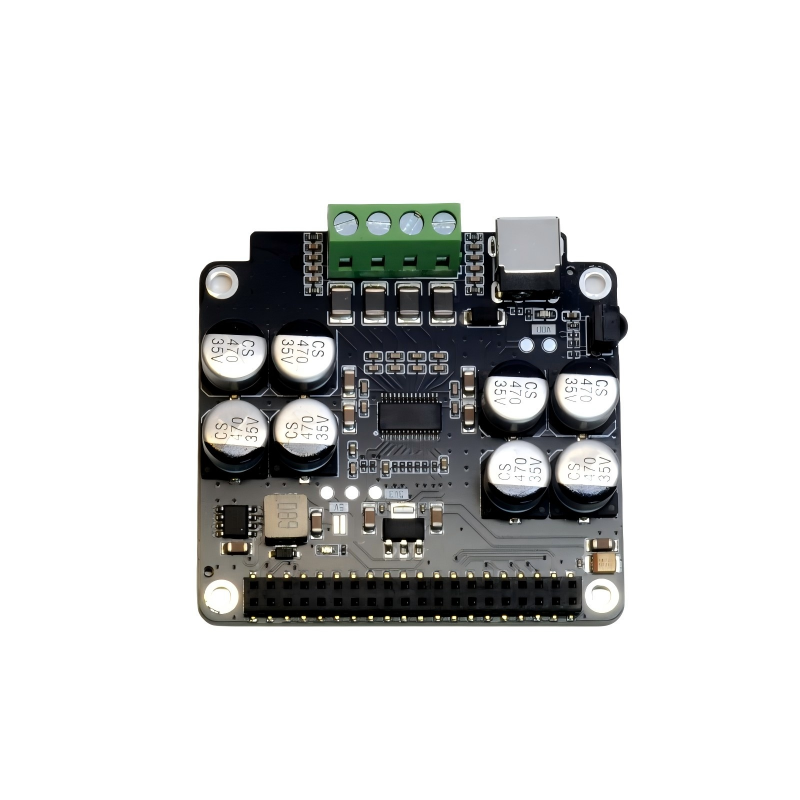


Louder Raspberry Hat
As low as
$20.00
Availability:
In stock
Only %1 left
SKU
PIA23807L
Weight
80g
Related Products:

×
 Add to cart successfully!


Add to cart successfully!
Customers Who View This Item Also Bought
Frequently Bought Together




What is it?
The Louder Raspberry Hat is a cost-effective, high-performance audio add-on for the Raspberry Pi. It pairs the Pi’s processing power with the Hi-Fi audio quality of TI’s TAS5805M DAC and an efficient Class-D output stage.
The Hat accepts an external power supply of up to 28 V and includes an onboard step-down converter to provide 5 V to the Raspberry Pi, allowing the entire system to run from a single power source. It uses the same highly capable DAC found in its larger siblings, delivering clean, powerful audio suitable for driving large speakers—or pushing small ones to their limits.
| 1X | 2X |
|---|---|
A recent addition to the family is a 2X Louder Raspberry Hat that utilizes two TAS5805M DACs connected in series to deliver a flexible speaker configuration with a dedicated subwoofer driver.
Key features
- TAS5805M DAC with integrated DSP and built-in amplifier
- Digital volume control (avoids loss of resolution compared to software volume)
- Gain digital control
- Parametric EQ (15xBQ per channel), 128-tap FIR, 3-band DRC, AGL
Use cases
Louder Raspberry Hat Plus is a flexible, open-source audio platform designed to fit into both smart homes and custom audio projects.
- Smart Home Audio, TTS & Automation Node Integrates with Home Assistant and Music Assistant for high-quality playback, text-to-speech, and event-driven announcements. Functions as both an audio endpoint and a networked automation node for sensors, triggers, and smart home workflows.
- Multi-Room Audio Infrastructure Use Louder Raspberry Hat as a Snapclient server and endpoint for perfectly synchronized distributed audio. Ideal for open, vendor-neutral whole-home or commercial audio systems.
- Standalone Network Player & Streaming Hub Run LMS/Squeezelite for a self-contained streaming device supporting Spotify Connect, AirPlay, and Logitech Media Server — no external computer required.
- Embedded Audio Processing & DSP Platform Execute real-time digital signal processing, filtering, effects, or audio analysis directly on-device. Suitable for smart speakers, alert systems, acoustic sensing, and custom audio interfaces.
- Networked Sensor & Interface Controller Combine audio output with GPIO control, sensors, buttons, displays, or actuators. Ideal for interactive installations, smart appliances, voice feedback devices, or industrial status systems.
- Educational Platform for Systems & Networking A practical teaching platform for embedded Linux-style workflows without full SBC overhead — covering networking, streaming protocols, real-time processing, IoT architectures, and open-source audio systems.
- Rapid Prototyping for Connected Products Designed for fast iteration of networked hardware products — from smart audio devices and notification systems to interactive kiosks and connected consumer electronics.
- Open Platform for Custom Products & DIY Builds With fully open firmware and tooling, Louder Raspberry Hat provides a flexible foundation for personal projects, research platforms, or commercial device development.
Features
| Louder Raspberry Hat | Louder Raspberry Hat Plus | |
|---|---|---|
| Image (2.0 model) | ||
| Image (2.1 model) | ||
| Compatible with | Every Pi | Every Pi |
| DAC | (1X) Stereo I2S DAC TAS5805M with built in D-Class amp(2X) Dual (2.1) I2S DAC TAS5805M with built in D-Class amp | (1X) Stereo I2S DAC TAS5825M with built in D-Class amp(2X) Dual (2.1) I2S DAC TAS5825M with built in D-Class amp |
| Output | [1X] 2x 22W (8Ω, 1% THD+N); 2x 32W (4Ω, 1% THD+N) at 20V 1x 45W (4Ω, 1% THD+N) at 20V [2X]: 2x 22W (8Ω, 1% THD+N) + 1x 45W (4Ω, 1% THD+N) | [1X] 2x 32W (8Ω, 1% THD+N); 2x 45W (4Ω, 1% THD+N) at 20V 1x 53W (4Ω, 1% THD+N) at 20V [2X]: 2x 32W (8Ω, 1% THD+N) + 1x 53W (4Ω, 1% THD+N) |
| IR input | ✅ | 1X model |
| Power requirement | 7..26V from external source, powering host (up to 3A cont.) | 7..26V from external source, powering host (up to 3A cont.) |
| Mechanical dimensions (WxHxD), Hat | 65mm x 56mm x 20mm | 65mm x 56mm x 20mm |
⚠️ Louder boards will connect to passive speakers; you can't use headphones or an external amp
💡 Need to connect an external amp? Check out HiFi Raspberry Hat
💡 Don't need DSP capabilities? Check out Loud Raspberry Hat
Board Pinout
| I2C CLK | I2C DATA | DAC PWDN | IR INPUT | I2S CLK | I2S DATA | I2S WS | |
|---|---|---|---|---|---|---|---|
| Raspberry Pi Hat 1X | 3 | 2 | 4 | 17 | 18 | 19 | 19 |
| Raspberry Pi Hat 2X | 3 | 2 | 4, 5 | 17 | 18 | 19 | 19 |
How to use
You can use any distribution you like. To enable the IR reader, you need to add 1 line to the /boot/config.txt
dtoverlay=gpio-ir,gpio_pin=17
TAS5805M DAC is not supported by default Raspbian distribution; therefore, some work needs to be done to enable it. The linked repo contains code and instructions on how to configure it. It will take you 5 minutes and one reboot.
Other software options
The project repository provides a few examples with build instructions, including Volumio setup instructions, among others.
Hardware
Please visit the hardware section of the project repo for board schematics and PCB designs. Note that PCBs are shared as multi-layer PDFs as well as Gerber archives.
PCB diagram
| 1X | 2X |
|---|---|
IR reader
Please follow this guide to configure an IR reader
TAS58xx DSP Capabilities (TAS5805M / TAS5825M)
Both TAS5805M and TAS5825M DACs feature sophisticated DSPs inside. The unified driver automatically detects which chip is connected based on I2C address and provides extensive control over DSP features through ALSA, eliminating the need for the $250+ evaluation board for most use cases.
Chip Detection: - TAS5805M: I2C addresses 0x2c - 0x2f (automatically detected) - TAS5825M: I2C addresses 0x4c - 0x4f (automatically detected)
Currently Implemented:
- EQ Modes: 4 modes selectable via device tree (
ti,eq-mode) - OFF (0): No equalization
- 15-band parametric EQ (1): Full frequency control with adjustable Q and gain
- LF Crossover (2): Low-pass filter for subwoofers (60-150Hz, Linkwitz-Riley 4th order)
- HF Crossover (3): High-pass filter for satellite speakers (60-150Hz, Linkwitz-Riley 4th order)
- Speaker Configurations: 2.0 stereo, 2.1 (with dual DAC), bridge/PBTL mono
- Mixer Controls: Flexible channel routing (Stereo, Mono, Left only, Right only)
- Analog Gain: 32 steps (0 to -15.5dB) for output level optimization
- Modulation Schemes: BD, 1SPW, Hybrid (efficiency vs. quality tradeoffs)
- Switching Frequency: 384kHz, 480kHz, 576kHz, 768kHz
- Bridge Mode: PBTL for maximum mono power output
- Fault Monitoring: Read-only ALSA controls for real-time hardware health monitoring
- Channel faults (overcurrent, DC fault)
- Power supply faults (PVDD under/overvoltage)
- Thermal warnings (4 levels: 112°C, 122°C, 134°C, 146°C)
- Clock and Digital Signal Processing faults
- Overcurrent warnings and shutdown detection
Power considerations
Below are the power requirements for different Pi models
| Model | Power requirement |
|---|---|
| Raspberry Pi Zero W | 260 mA (1.3 W) |
| Raspberry Pi Zero 2 W | 500 mA (2.5 W) |
| Raspberry Pi 3 Model B | 1.34 A (6.7 W) |
| Raspberry Pi 3 Model B+ | 1.21 A (6.05 W) |
| Raspberry Pi 3 Model A+ | 0.75 A (3.75 W) |
| Raspberry Pi 4 Model B (1GB, 2GB, 4GB, and 8GB RAM variants) | 3.0 A (15 W) |
| Raspberry Pi 5 | Approximately 3.5 A |
Consider expected audio output to be a part of the power budget and buy a reasonable power source capable of delivering the sum of Pi and audio requirements with a reasonable margin of 15%+
In the extreme scenario, using 2 channels with a 4-Ohm load with Pi5, you'd need (15W [Pi] + 60W [audio]) * 1.2 = 90W, round up to 100W.
Sponsorship & Community Support
If you’re working on an open-source project, an educational initiative, or any pro-bono/volunteer effort, feel free to reach out for sponsorship details. I’ll do my best to provide discounts or even free boards.
Custom Design & Consultation
If you’re interested in a custom design based on or inspired by my boards, I also offer contract design work and consultation when needed.
Write Your Own Review
Bestselling Products You May Like


New Products You May Want


Warranty
Service

VIP Distributor
Discount

Professional
Tech Support
