Currency
Toggle Nav

Meet the ThinkNode M8: Off-Grid Meshtastic Communication, Now on Your Wrist
November 20, 2026
New Release · In Stock
Meet the ThinkNode M8: Off-Grid Meshtastic Communication, Now on Your Wrist
A rugged Meshtastic smartwatch with E-Ink display, LoRa mesh radio, and full-day battery — built for the places your phone can't reach.
Halfway up the trail, your phone gives up. One bar flickers, then nothing. Your group is fifty meters ahead, someone has wandered off to check the map, and the path forks in two directions. In that moment, the device strapped to your wrist matters more than the one in your pocket.
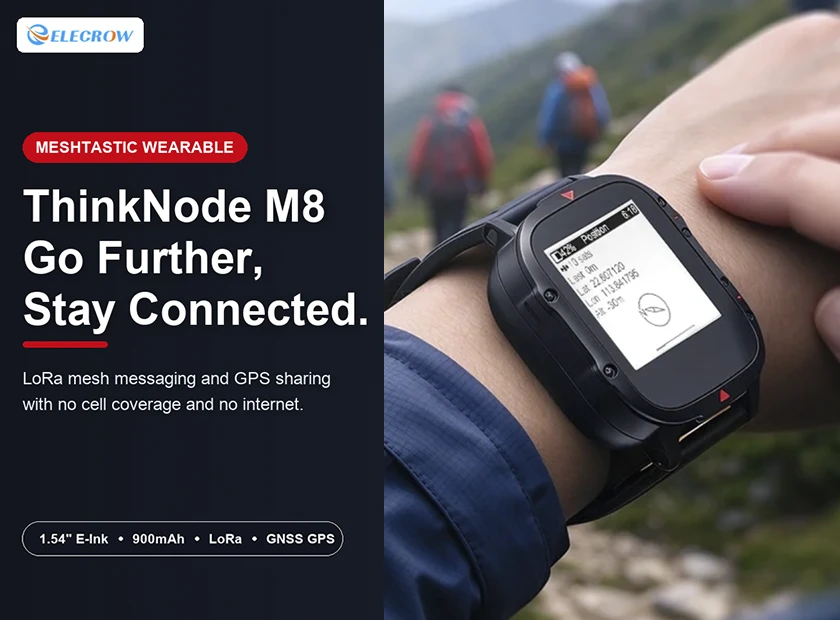
That's the situation the ThinkNode M8 was built for. Elecrow's newest Meshtastic device takes the company's off-grid mesh communication platform and shrinks it into a rugged smartwatch — and it's here now, newly launched and in stock for the first time.
In This Article
- When the bars disappear
- The ThinkNode M8 at a glance
- A screen that works with the sun
- Two radios, one job
- Battery that matches the length of your day
- Know where you are
- Built to be worn outside
- Where the M8 earns its place
- One mesh, many shapes: the ThinkNode family
- Who the M8 is for
- Frequently asked questions
When the bars disappear
Cell coverage is good until it isn't. Canyons block signals. Forests swallow them. Mountain ridges, deep valleys, festival grounds, storm-damaged infrastructure — dead zones are everywhere, and they tend to appear exactly where people spread out.
Mesh networking sidesteps the problem rather than fighting it. A Meshtastic device like the M8 sends short text messages and position data over LoRa radio, and every powered-up node in range relays messages for the others. A message can hop across a chain of devices to reach someone well beyond direct radio range. No towers, no subscriptions, no SIM card.
Range depends on terrain, antennas and how many nodes stand between you and the person you're messaging. In open country, LoRa links routinely stretch for kilometers; in forest or urban terrain each hop is shorter, but every additional device makes the whole network stronger.
The ThinkNode M8 at a glance
The M8 is the first wearable in the ThinkNode family. Inside its zinc alloy case sits the same proven radio pairing that anchors the series: a Nordic nRF52840 processor working with a Semtech SX1262 LoRa transceiver, running Meshtastic firmware out of the box.
Here's what sits on your wrist:
| Display | 1.54-inch E-Ink, 200 × 200 resolution |
|---|---|
| LoRa Radio | SX1262 transceiver — 868 MHz and 915 MHz regional versions |
| Bluetooth | 5.4 for pairing with the Meshtastic app |
| Positioning | High-precision GNSS for positioning and location sharing |
| Battery | 900 mAh with over-charge and over-discharge protection |
| Sensors | 3-axis accelerometer and an RTC real-time clock |
| Controls | Rotary crown, function keys and an 8 Ω / 1 W speaker for audible alerts |
| Size & Weight | 80 g with silicone strap — 60.3 × 44.3 × 15.5 mm on the wrist |
Ready Out of the Box
Meshtastic firmware comes pre-installed — the M8 joins an existing mesh network the moment you power it on. No flashing, no configuration marathons.
A screen that works with the sun, not against it
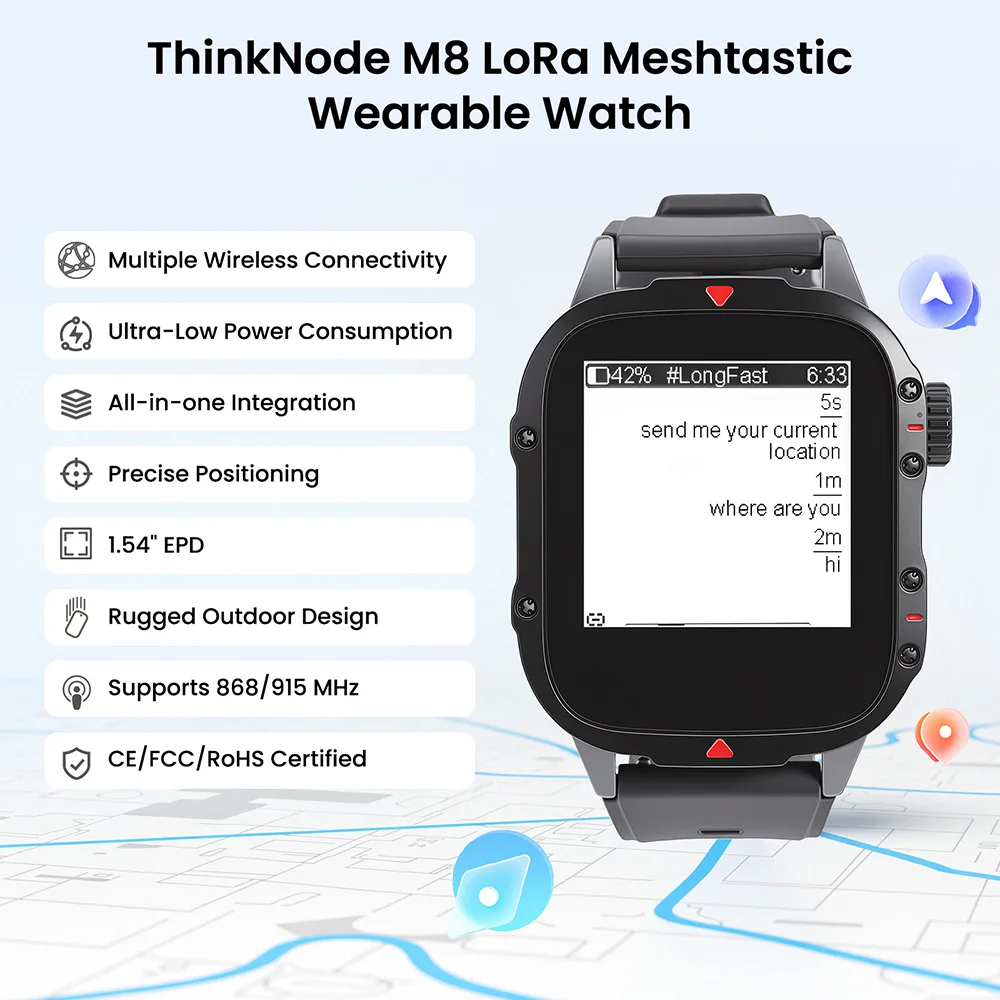
The 1.54-inch E-Ink panel is the kind of display you pick when the outdoors comes first. It stays readable in direct sunlight, doesn't wash out when viewed at an angle, and — the part that matters most for battery life — only draws power when the image changes. The time, your coordinates, incoming messages and mesh status can sit on screen without consuming energy to stay there.
There's no touch layer, and that's deliberate. A rotary crown scrolls pages and adjusts the backlight, while physical function keys handle alarm and sleep. Gloved hands, cold fingers, rain on the casing: buttons and knobs don't care.
Two radios, one job
The SX1262 handles the long-range work on 868 or 915 MHz. It's the workhorse radio of the Meshtastic ecosystem, and because the firmware comes pre-installed, the M8 joins an existing mesh network the moment you power it on — no flashing, no configuration marathons.
Bluetooth 5.4 covers the short haul. Pair the watch with the official Meshtastic app on your phone to set up channels, view the live map and type messages with a real keyboard. For quick checks, the device itself runs the standard Meshtastic MUI, so coordinates, battery state and node lists are always one knob-turn away.
Battery that matches the length of your day
A communication tool that dies at noon isn't much use on a full-day hike. The M8 packs a 900 mAh lithium-polymer cell behind an intelligent power management system, designed to sustain all-day, high-frequency mesh communication. The E-Ink screen does its share: with power spent only on refresh, the display barely registers on the power budget.
When you do need to top up, a magnetic USB-C cable snaps onto the watch — 5 V / 1 A — with over-charge and over-discharge protection built in. A quick press of the function key puts the watch into sleep mode when the trail goes quiet.
Know where you are — and where everyone else is
The M8's GNSS receiver records your track in real time and shares your position across the mesh, so a group coordinator — or a worried partner at home with a bridged node — can see where the team actually is, not where it was an hour ago. An RTC clock keeps time synchronized and gives the GNSS a faster warm start, while the 3-axis accelerometer opens the door to motion-aware applications.
If something goes wrong, the built-in 8 Ω / 1 W speaker raises an audible alarm that carries further than a vibration.
Built to be worn outside
This is not a smartwatch that fears weather. The zinc alloy body and shock-resistant silicone strap balance light weight against the knocks of trail life, and the whole package is dustproof and waterproof for everyday use — sweat, rain and dust are all part of the design brief. It carries CE, FCC and RoHS certification, and runs in temperatures from 0 °C to 50 °C.
Where the M8 earns its place
Group Hikes & Backcountry Trips
Split up to scout a route, send a quick text from the fork in the trail, and everyone's watch updates.
Emergency Preparedness
Power outages, storms and network congestion are precisely when phones fail and mesh networks keep working. Keep an M8 charged in your go-bag.
Events & Volunteer Coordination
Marathons, festivals, search exercises: anywhere staff spread across a large area and radios are impractical.
Remote Work Sites
Farms, survey jobs, field research stations — places with work to coordinate and no bars to do it with.
Private Local Networks
Meshtastic channels are encrypted, and nothing touches the internet unless you deliberately bridge it.
One mesh, many shapes: the ThinkNode family
The M8 doesn't exist in isolation. Elecrow's ThinkNode series covers most roles a Meshtastic network needs, and the devices are designed to work side by side on the same mesh.
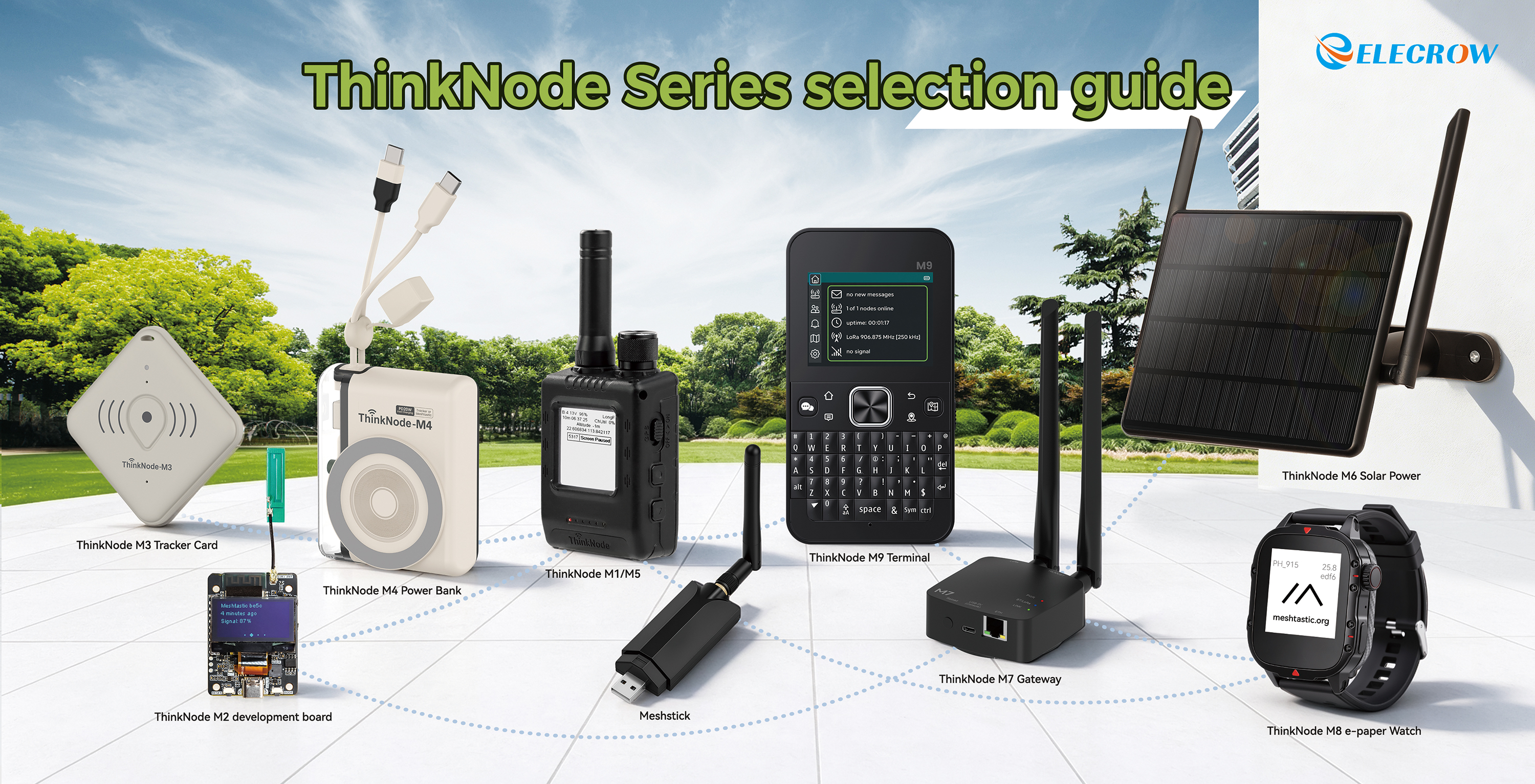
ThinkNode M1
The Low-Power HandheldBuilt on the same nRF52840 + SX1262 combination as the M8, the M1 wraps a 1.54-inch E-Paper display, GNSS and a 1200 mAh battery into a pocket communicator good for over 48 hours of continuous use. Its external antenna and physical knob make it the natural base-camp companion to an M8 on each wrist.
ThinkNode M3
The TrackerWhen the job is knowing where people, vehicles or equipment are, the M3 is purpose-built for it: a 40 g, IP66-rated tracker with multi-constellation GNSS, temperature and humidity sensing, offline data caching, and a one-click search function when it goes missing. Pair an M3 with each vehicle and an M8 with each person, and the mesh map tells the whole story.
ThinkNode M9
The Standalone CommunicatorFor anyone who types more than they hike, the M9 packs an ESP32-S3, a 2.4-inch color display and a full 37-key QWERTY keyboard into a phone-sized terminal with a 2300 mAh battery. It's the device you hand the coordinator at base camp while the M8 stays on the field team's wrists.
ThinkNode M6
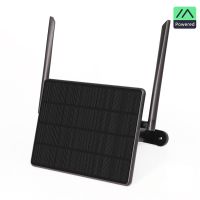
Solar-Powered NodeBrings solar-powered outdoor infrastructure to the mesh with a 6 W panel and 7000 mAh of storage — the fixed node that keeps a valley-wide network alive without grid power.
ThinkNode M7
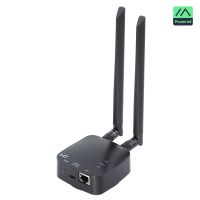
Fixed-Site GatewayAnchors a fixed site with Ethernet and PoE. The always-on node that bridges your local mesh to the internet when you choose to.
Meshstick
Pi-Powered RadioPlugs a LoRa radio straight into a Raspberry Pi. The easiest way to turn an existing Pi project into a Meshtastic node.
One Network, Many Nodes
Whether your network is three watches on a hiking trail or a valley-wide mesh of fixed nodes, there's a ThinkNode-shaped piece for it. All devices run the same open Meshtastic protocol and work on the same channel settings.
Who the M8 is for
The M8 fits on the wrist of anyone whose plans regularly outrun cell coverage: hikers, climbers, campers and cyclists; emergency-preparedness households building a communications plan; event staff and volunteers; professionals working beyond the grid; and the growing community of Meshtastic and IoT enthusiasts who simply enjoy watching a self-built network come alive.
Frequently asked questions
Does the M8 need a smartphone to work?
No. The watch communicates over LoRa mesh completely on its own using the built-in Meshtastic interface. A phone connected over Bluetooth 5.4 adds conveniences like map view and keyboard messaging.
Should I choose the 868 MHz or 915 MHz version?
It depends on your region — 868 MHz suits Europe, while 915 MHz is intended for the US and other supported areas. Check your local regulations before ordering.
How long does the battery last?
That depends on how chatty your mesh is, but the 900 mAh cell is designed for all-day, high-frequency communication, and the E-Ink display plus sleep mode stretch standby time considerably.
Is the M8 waterproof?
It's dustproof and waterproof for everyday use — sweat, rain and dust are fine. It isn't rated for swimming or submersion.
Can the M8 talk to other Meshtastic devices?
Yes. It runs the open Meshtastic protocol, so it works with other ThinkNode devices, third-party nodes and the official apps on the same channel settings.
Why the ThinkNode M8 stands out
Phones are brilliant right up to the edge of coverage. The ThinkNode M8 keeps working past it — a LoRa mesh radio, a sunlight-readable E-Ink screen and a full day of battery on your wrist, with no tower required. It's the newest member of a family that already spans handhelds, trackers, keyboards, solar nodes and gateways, so the network you start with one watch has somewhere to grow.
The ThinkNode M8 is newly launched and available now. Strap one on, power it up, and watch the mesh appear.
The ThinkNode M8 is in stock and shipping now. Join thousands of builders running their own mesh network.
Related Products