
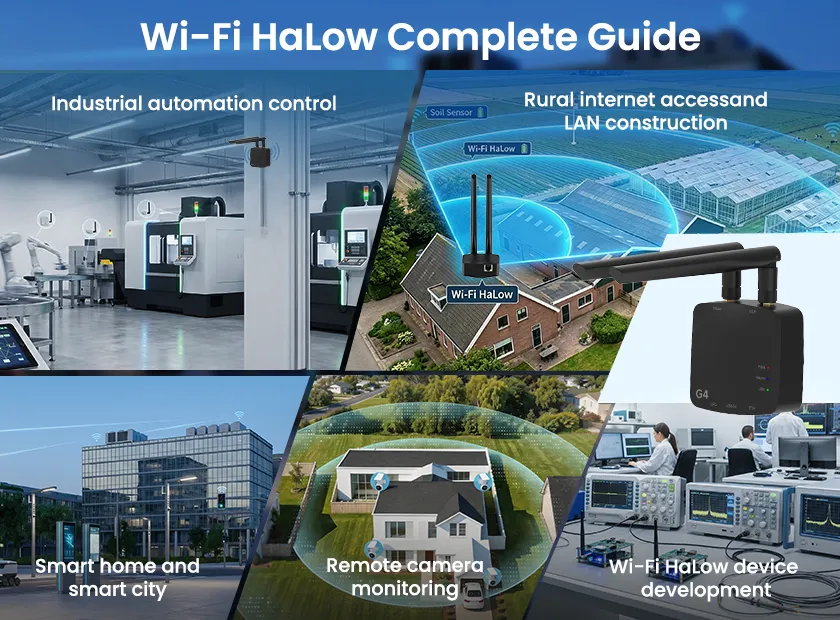
Wi-Fi HaLow (IEEE 802.11ah) may be the most underrated wireless communication technology to emerge in recent years. It inherits Wi-Fi's native IP stack and mature security architecture, yet drops the operating frequency down to Sub-1 GHz (850–950 MHz), delivering kilometer-scale coverage, superior wall penetration, and low-power IoT optimization that traditional Wi-Fi simply cannot match. If you've ever struggled with LoRa's data rate being too low to transmit images, wrestled with Zigbee's mesh complexity, or deployed a forest of repeaters because standard Wi-Fi couldn't reach your backyard — Wi-Fi HaLow is likely the "sweet spot" technology you've been searching for. Market research firm ABI Research predicts annual Wi-Fi HaLow device shipments will grow from roughly 19 million units in 2025 to 124 million by 2030, a compound annual growth rate (CAGR) of 45% — the fastest of any wireless connectivity technology.
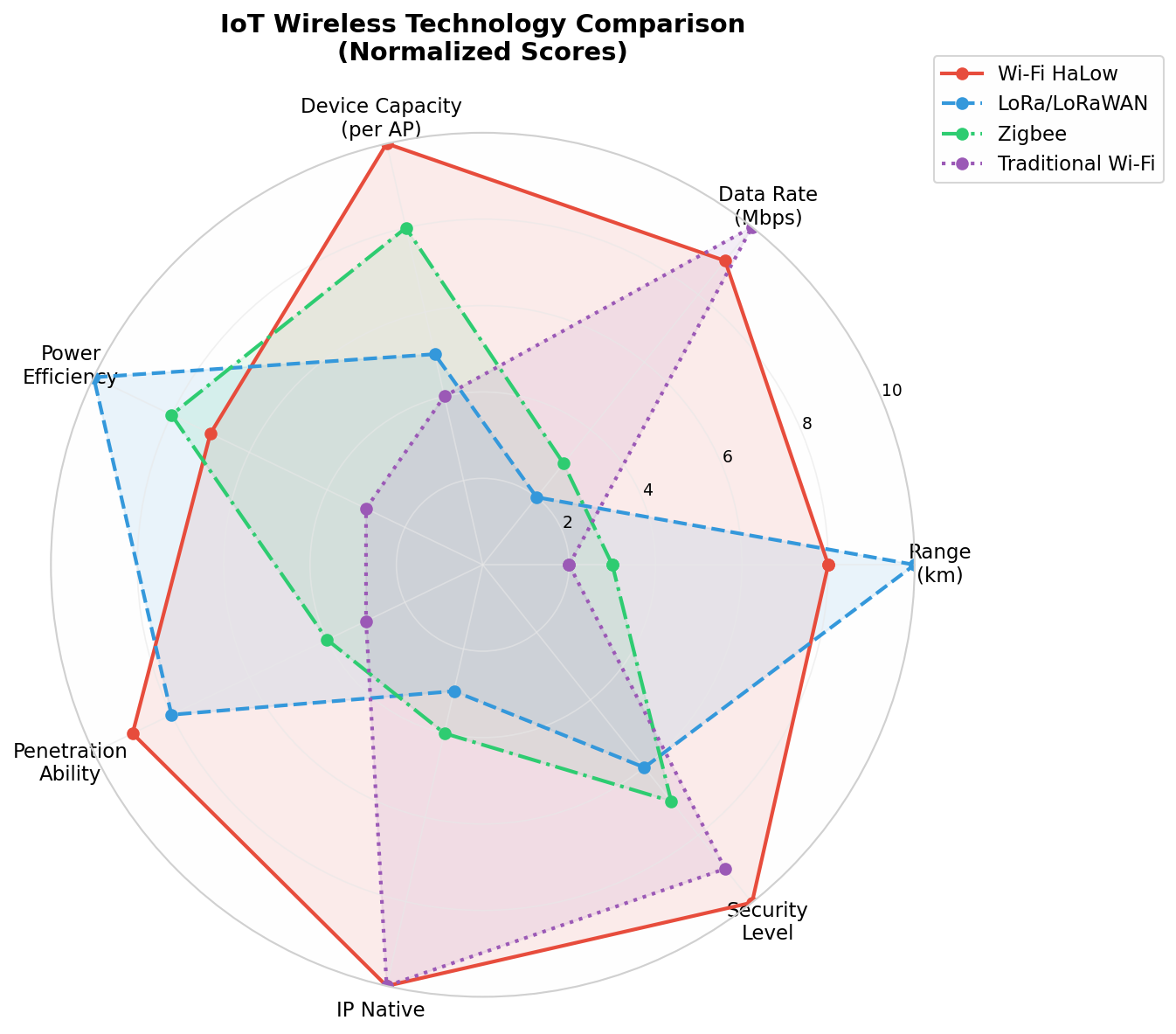
Figure 1: IoT Wireless Technology Comparison — HaLow dominates in range, penetration, IP nativity, and security while maintaining competitive data rates.
1. What Exactly Is Wi-Fi HaLow?
Wi-Fi HaLow is a Wi-Fi variant based on the IEEE 802.11ah standard, formally named and promoted by the Wi-Fi Alliance in 2016. Unlike conventional Wi-Fi operating at 2.4 GHz, 5 GHz, or 6 GHz, HaLow works in the unlicensed Sub-1 GHz bands (902–928 MHz in the United States). The physics of this frequency band inherently provide stronger diffraction and obstacle penetration — according to the Free Space Path Loss (FSPL) formula, lower frequencies attenuate more slowly. Dropping from 2.4 GHz to 900 MHz gives HaLow roughly 8.5 dB of additional link budget, which in real-world terms means the signal can punch through several extra walls.
HaLow's core design mission is to solve three pain points of traditional Wi-Fi in IoT scenarios: insufficient coverage, excessive power consumption, and limited device density. By narrowing channel bandwidth (selectable 1/2/4/8/16 MHz), adopting OFDM modulation with multiple coding schemes (BPSK to 256-QAM), and introducing a suite of MAC-layer power optimizations (such as Target Wake Time / TWT), HaLow pushes the theoretical per-AP device capacity to 8,191 stations while extending coverage radius beyond 1 kilometer.
1.1 Physical Layer & Modulation
HaLow's PHY design is remarkably elegant — its 2/4/8/16 MHz bandwidth modes are essentially a 1/10 frequency-downscaled version of IEEE 802.11ac (Wi-Fi 5) 20/40/80/160 MHz modes. For example, HaLow's 2 MHz mode and 802.11ac's 20 MHz mode both use 64 subcarriers (52 data + 4 pilot), but the subcarrier spacing is one-tenth. This allows HaLow to reuse a vast amount of proven Wi-Fi intellectual property while gaining the propagation advantages of Sub-1 GHz.
| MCS Index | Modulation | Coding Rate | 1 MHz (Mbps) | 2 MHz (Mbps) | 4 MHz (Mbps) | 8 MHz (Mbps) | 16 MHz (Mbps) |
|---|---|---|---|---|---|---|---|
| MCS0 | BPSK | 1/2 | 0.15 | 0.65 | 1.35 | 2.93 | 5.85 |
| MCS1 | QPSK | 1/2 | 0.30 | 1.30 | 2.70 | 5.85 | 11.7 |
| MCS2 | QPSK | 3/4 | 0.45 | 1.95 | 4.05 | 8.78 | 17.6 |
| MCS3 | 16-QAM | 1/2 | 0.60 | 2.60 | 5.40 | 11.7 | 23.4 |
| MCS4 | 16-QAM | 3/4 | 0.90 | 3.90 | 8.10 | 17.6 | 35.1 |
| MCS5 | 64-QAM | 2/3 | 1.20 | 5.20 | 10.8 | 23.4 | 46.8 |
| MCS6 | 64-QAM | 3/4 | 1.35 | 5.85 | 12.2 | 26.3 | 52.7 |
| MCS7 | 64-QAM | 5/6 | 1.50 | 6.50 | 13.5 | 29.3 | 58.5 |
| MCS8 | 256-QAM | 3/4 | — | — | 16.2 | 35.1 | 70.2 |
| MCS9 | 256-QAM | 5/6 | — | — | 18.0 | 39.0 | 86.7 |
| MCS10 | BPSK (repeated) | 1/2 | 0.15 | — | — | — | — |
Source: IEEE 802.11ah standard documentation and CWNP PHY whitepaper.
As shown above, HaLow's data-rate span is extraordinarily wide: 150 kbps (MCS10, 1 MHz) to 86.7 Mbps (MCS9, 16 MHz). This flexibility lets developers trade off between maximum range (1 MHz + MCS10, receive sensitivity down to -109 dBm) and higher throughput (16 MHz + MCS9). Newracom's measured data shows its NRC7292 chip achieves -109 dBm sensitivity at 1 MHz / MCS10, and still reaches -81 dBm at 4 MHz / MCS7.
1.2 MAC-Layer Power-Saving Black Magic
HaLow introduces multiple MAC-layer energy-saving mechanisms purpose-built for IoT, giving it battery life comparable to LoRaWAN:
Target Wake Time (TWT): HaLow's flagship power-saving feature. Devices negotiate a "wake-up schedule" with the AP, powering up their radio only during designated time windows to transmit or receive, then returning to deep sleep. TWT intervals can be configured from microseconds to years — for a soil sensor that reports once per day, a 24-hour TWT interval yields near-zero standby power.
Restricted Access Window (RAW): The AP groups large populations of devices and assigns each group a dedicated channel-access slot. This is critical in dense deployments — RAW supports up to 8,192 devices per group, dramatically reducing collision probability through time-slicing.
Non-TIM Mode: Traditional Wi-Fi devices must frequently wake to listen for AP Beacon frames (which carry TIM, indicating buffered downlink traffic). HaLow supports optional Non-TIM mode, freeing devices from continuous Beacon monitoring and further cutting power.
According to Wi-Fi Alliance's IMED comparative study, a HaLow device with a 500 mAh battery transmitting every 10 minutes achieves a battery life of 3.15 years. More strikingly, Queensland University of Technology research shows that although LoRaWAN wins on absolute per-transaction power, HaLow completes the same data transfer 400× faster. On the "bits per joule" metric, HaLow is 7× more energy-efficient than LoRaWAN, delivering up to 50% longer real-world battery life.
2. Wi-Fi HaLow vs. Other IoT Wireless Technologies
For makers and engineers selecting a wireless link, understanding the trade-offs between technologies is essential. Below is a systematic multi-dimensional comparison of Wi-Fi HaLow against LoRa/LoRaWAN, Zigbee, BLE 5.0, NB-IoT, and traditional Wi-Fi.
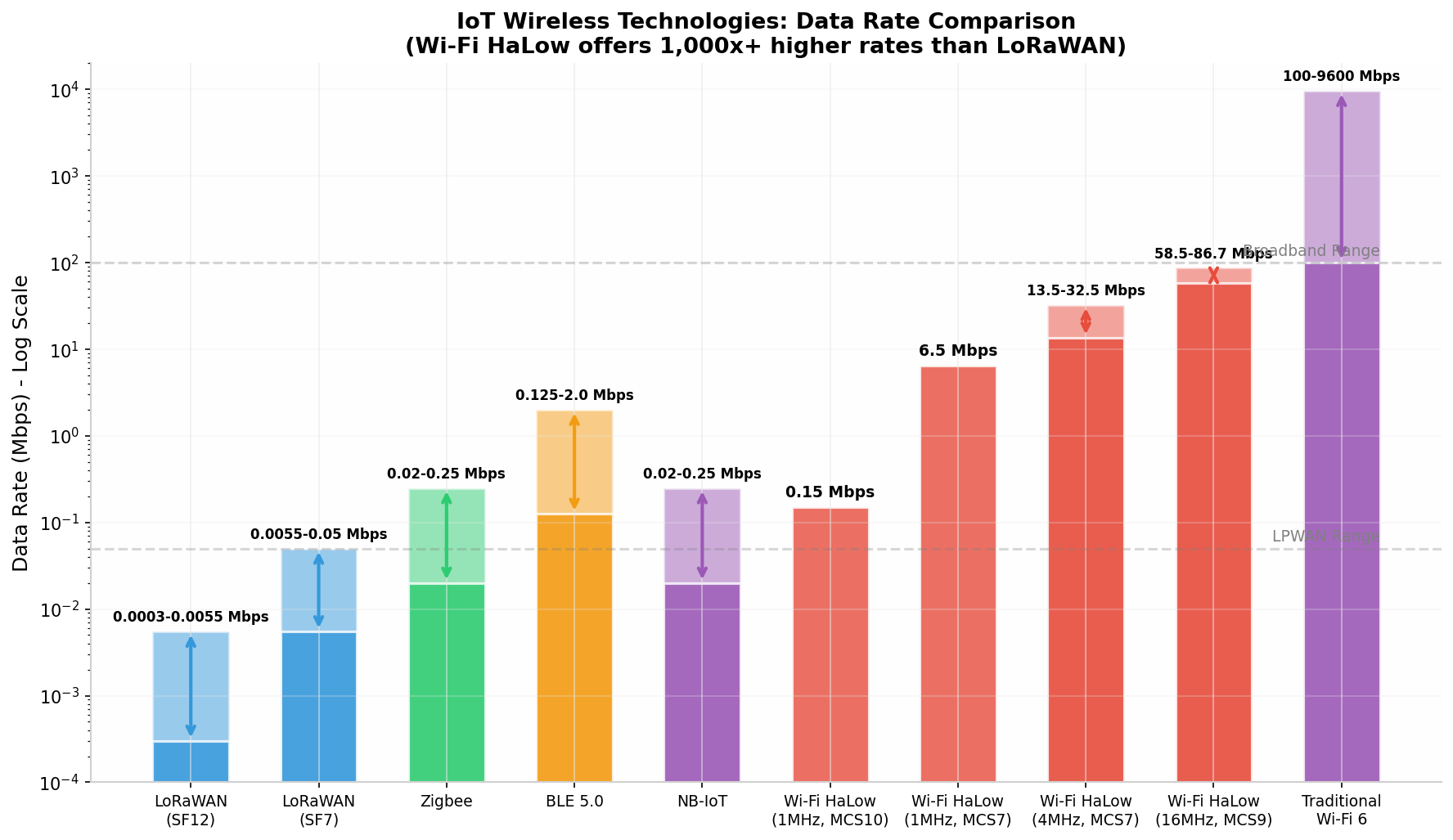
Figure 2: Data Rate Comparison — HaLow bridges the gap between LPWAN and broadband, offering 1,000×+ higher rates than LoRaWAN.
2.1 Core Technical Parameters
| Parameter | Wi-Fi HaLow (802.11ah) |
LoRa/LoRaWAN | Zigbee (802.15.4) |
BLE 5.0 | NB-IoT | Traditional Wi-Fi |
|---|---|---|---|---|---|---|
| Operating Band | Sub-1 GHz (902–928 MHz etc.) |
Sub-1 GHz (868/915 MHz) |
2.4 GHz (or 868/915 MHz) |
2.4 GHz | Licensed cellular | 2.4/5/6 GHz |
| Typical Range | Urban 1 km+, Rural 16 km | Urban 5 km, Rural 15–20 km | 10–100 m | 50–100 m | 1–10 km | 30–100 m |
| Data Rate | 150 kbps – 86.7 Mbps | 0.3 – 50 kbps | 250 kbps | 125 kbps – 2 Mbps | 20 – 250 kbps | 100+ Mbps |
| Per-AP/Gateway Capacity | 8,191 devices | Thousands (airtime-limited) |
65,000+ (mesh) |
Limited | 100,000/cell | 2,007 devices |
| Typical Latency | Millisecond-level | Seconds to minutes | Millisecond-level | Millisecond-level | Seconds | Millisecond-level |
| Native IP | Yes (IPv4/IPv6) | No (gateway translation required) | No | No | Yes | Yes |
| Security | WPA3 / Enterprise | AES-128 | AES-128 | AES-128 | SIM-grade | WPA2/WPA3 |
| Topology | Star (AP-STA) | Star-of-stars (gateway) | Mesh | Star/Mesh | Star (cellular) | Star (AP) |
| Spectrum Cost | Free (unlicensed) | Free (unlicensed) | Free | Free | License fees | Free |
| Gateway/AP Cost | $100 – $1,000 | $100 – $1,000 | None (self-forming) | None | $15,000+ | $50 – $200 |
Source: Silex Technology whitepaper, CWNP, Wi-Fi Alliance technical docs, WBA field test reports.
2.2 Use-Case Quick Reference
Each technology has its "sweet spot." LoRaWAN still dominates ultra-long-range, ultra-low-data-rate scenarios such as remote environmental monitoring and agricultural sensors. Zigbee and BLE are best for indoor short-range applications — smart home device meshing and wearable connections. NB-IoT relies on carrier infrastructure, suiting nationwide-coverage use cases like smart water meters and shared bikes where ongoing subscription fees are acceptable.
Wi-Fi HaLow's unique value is filling the "middle ground" — applications that need higher data rates than LoRaWAN (image transmission, firmware OTA), longer range than traditional Wi-Fi, and the benefits of native IP plus unlicensed spectrum. As Andrew Brown, IoT Practice Lead at Omdia, notes: "If HaLow can establish a beachhead in video transmission, that infrastructure can subsequently be used for non-video IoT applications such as sensors, actuators, and lighting controls — even where HaLow holds no obvious technical advantage, the mere existence of the infrastructure makes it more attractive than deploying another wireless technology."
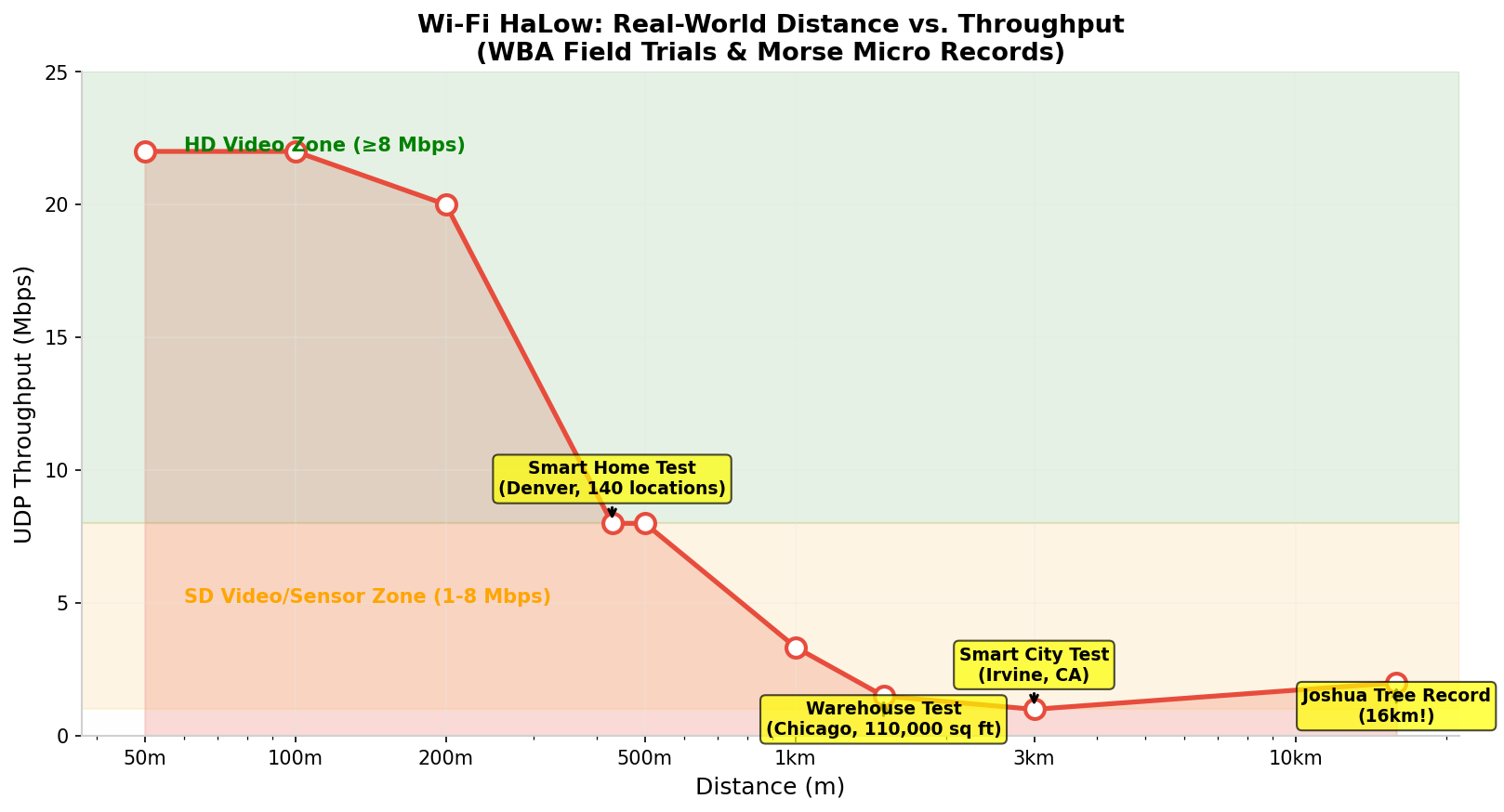
Figure 3: Real-World Distance vs. Throughput — From 22 Mbps at 50 m to 2 Mbps at 16 km, HaLow covers the full spectrum.
2.3 Complement, Not Replace: Why HaLow and LoRaWAN Coexist
It is important to emphasize that Wi-Fi HaLow was not designed to displace LoRaWAN or any other technology. The two can even collaborate — industry demonstrations have already shown HaLow serving as a long-range wireless backhaul link for LoRaWAN gateways, replacing Ethernet in locations where cabling is impossible. For makers, this means you can choose flexibly based on project needs: need to stream camera footage? Pick HaLow. Need to place a temperature sensor on a mountaintop 10 km away and change the battery once a year? Pick LoRaWAN.
3. Real-World Performance: WBA Field Trials
The Wireless Broadband Alliance (WBA) has organized the world's largest Wi-Fi HaLow field-test program since 2023, spanning seven scenarios from smart homes to industrial IoT. These trials, supported by Morse Micro, Newracom, and Methods2Business, were conducted in real urban environments across North America.
3.1 Smart Home: Single AP, 3-Acre Coverage
In a 5,000 sq ft residence and surrounding 3-acre property in Denver, Colorado, a single Wi-Fi HaLow AP achieved complete indoor and outdoor coverage. Across 140 indoor test points, high-demand zones delivered over 8 Mbps, while typical usage scenarios exceeded 2 Mbps. The system simultaneously managed 23 concurrent devices and maintained stable connectivity at 430 meters from the AP outdoors. Notably, a 25 MB firmware OTA update completed in just 30 seconds (~20 Mbps) — a task virtually impossible for low-speed technologies like LoRaWAN.
3.2 Smart Warehouse: 110K sq ft Under One AP
In a 110,000 sq ft (~10,200 m²) warehouse near Chicago, HaLow demonstrated formidable industrial penetration. A single centrally placed AP delivered 22 Mbps in the core and maintained over 1 Mbps at the edges. Outdoor connectivity tests showed strong signals at 1,500 ft (~457 m). Redundancy tests confirmed that when the primary AP failed, devices re-associated to a backup AP within seconds, ensuring business continuity.
3.3 Smart Farm: 14-Acre Agricultural Campus
Scott Farm Market and Greenhouse in Kent, Ohio — covering 14 acres (~5.7 ha) — provided an ideal testbed for agricultural HaLow applications. At the most challenging measurement points (obstructed by greenhouse structures and vegetation), HaLow still maintained 1.3 Mbps; near-AP areas reached 22 Mbps. The test system supported 24 IoT devices (simulating farm sensors and actuators) alongside multi-channel camera security, showcasing HaLow's ability to handle both sensor data and video streams concurrently.
3.4 Smart City: 1 km Radius
During smart-city testing in Irvine, California, the HaLow AP achieved a 1 km radius of coverage, extending along Irvine Center Drive to 1.5 miles (~2.4 km). Even in weaker-signal zones, connections remained stable and reliable, supporting security monitoring and asset-tracking applications.
3.5 Morse Micro's 16 km World Record
In September 2024, Morse Micro conducted an extreme-range test in Joshua Tree National Park, California. Using a standard MM6108-EKH01 evaluation kit (Raspberry Pi 4 + MM6108 module, 21 dBm output, 1 dBi low-gain dipole antenna) — no high-gain directional antennas or out-of-spec transmit power — HaLow achieved stable 2 Mbps UDP throughput at a distance of 15.9 km, successfully carrying a video call.
This result is grounded in the IEEE 802.11ah standard's Slot Time parameter — the standard specifies a Slot Time of 52 µs, corresponding to a maximum electromagnetic round-trip propagation distance of approximately 15.9 km. Morse Micro's chip strictly adheres to this standard, so the test effectively validated the theoretical maximum distance of 802.11ah. At 2 Mbps, the throughput is fully usable for peer-to-peer applications (body cameras, outdoor intercoms) and agricultural/mining IoT scenarios.
| Scenario | Location | Coverage | Typical Throughput | Key Finding |
|---|---|---|---|---|
| Smart Home | Denver, CO | 5,000 sq ft + 3 acres | 2–8 Mbps | Single-AP whole-home + yard, 23 devices concurrent |
| Smart Warehouse | Near Chicago, IL | 110,000 sq ft | 1–22 Mbps | 1,500 ft outdoor link, fast AP failover |
| Smart Farm | Kent, OH | 14 acres | 1.3–22 Mbps | 24 IoT devices + multi-camera security concurrent |
| Smart City | Irvine, CA | 1 km radius / 1.5 mi road | 3.34 Mbps (PHY) | Reliable urban complex-environment links |
| Extreme Range | Joshua Tree, CA | 15.9 km | 2 Mbps UDP | Validates 802.11ah theoretical maximum distance |
4. Maker Project Ideas Powered by HaLow
For makers, DIY enthusiasts, and radio amateurs, HaLow's real appeal lies in opening application spaces that neither traditional Wi-Fi nor LoRa can perfectly cover. Here are project concepts based on HaLow's technical characteristics to spark your imagination.
4.1 Rural Last-Mile Broadband (DIY)
In many suburban or rural areas, fiber-to-the-home costs are prohibitively high. HaLow's 1–3 km coverage and multi-ten-Mbps data rates make it a viable "last mile" wireless access solution. Imagine a DIY project: mount a HaLow AP on a neighbor's roof where broadband is available, connect to your roof-mounted HaLow client via directional antennas, then bridge to a standard 2.4/5 GHz Wi-Fi router for household use. No carrier involvement, no monthly fees, hardware cost under $100–$300. The Elecrow ThinkNode G4 is particularly well-suited here — its Ethernet port lets you wire into the neighbor's router, while its dual-band Wi-Fi can serve your local devices, all managed through a simple Web UI.
At CES 2025, Morse Micro demonstrated a tri-band router concept (2.4 GHz + 5 GHz + Sub-1 GHz HaLow), signaling the future of consumer-grade HaLow routers.
4.2 Remote Security Cameras Without Cable Runs
Traditional Wi-Fi cameras in outdoor deployments often require complex cabling or relay schemes. HaLow's Sub-1 GHz signal easily traverses walls and vegetation, enabling hundreds-of-meters to one-kilometer wireless video backhaul. Elecrow has released a ESP32-S3 + FGH100M HaLow chip camera development board (2 MP camera, Arduino IDE support), priced around $30–$50. Project ideas include:
- Farm/orchard perimeter monitoring: AP indoors, camera on a fence post hundreds of meters away — completely wireless.
- Construction site / temporary venue monitoring: Rapid deployment, no wiring, easily relocated when the project ends.
- Wildlife observation: Solar-powered, long-term remote shooting in the wild.
4.3 Large-Campus Sensor Networks
If you operate a large greenhouse, warehouse, or livestock facility, HaLow lets you replace dozens of Zigbee/LoRa gateways with a single AP. Imagine a sensor network: soil moisture, temperature, light, and CO₂ sensors distributed across thousands of square meters, all feeding into one AP, then uploading to cloud or local server via standard MQTT, HTTP, or CoAP. Because HaLow is IP-native, no Network Server or Application Server infrastructure (as required by LoRaWAN) is needed. An Elecrow ThinkNode G4 placed at the center of a greenhouse or warehouse can serve as that single aggregation point — its Ethernet backhaul connects directly to your server or cloud router, while the built-in Web UI lets you monitor connected devices and adjust parameters without writing a line of code.
WBA's farm trial already proved that HaLow can simultaneously support 24 sensors + multi-channel video across 14 acres — a combination traditional solutions struggle to achieve.
4.4 Community Emergency Communications
For radio amateurs and emergency communications (EMCOMM) communities, HaLow offers a powerful new tool. In a disaster scenario where cellular networks fail (earthquake, hurricane), community volunteers can rapidly deploy HaLow APs as local communication backbones, with residents using HaLow terminals for voice calls, text messaging, and location sharing. HaLow's WPA3 enterprise-grade encryption ensures secure communications, and its IP-native architecture allows standard applications to run without specialized gateways.
4.5 Long-Range Drone / Robot Control
HaLow's kilometer-scale coverage + low latency makes it an ideal control link for drones and ground robots. Compared to Wi-Fi, HaLow offers stronger interference resilience (Sub-1 GHz avoids the crowded 2.4 GHz band); compared to LoRa, HaLow provides enough bandwidth for low-latency video backhaul (FPV). Chris King, Sales Manager at Teledatics, notes: "We're seeing strong demand for long-range drone control and video transmission, especially in agriculture."
4.6 Smart Meter & Energy Management
Australia, Japan, the United States, and Indonesia are actively exploring HaLow-based smart meter deployments. For advanced makers, build a home energy monitoring dashboard: HaLow connects smart meters, solar inverters, battery storage, and EV chargers through a single AP. HaLow's Sub-1 GHz signal penetrates metal meter boxes and electrical room walls — something 2.4 GHz Wi-Fi struggles to do.
4.7 Dual-Stack Gateway: HaLow + LoRaWAN
For geeks who want "the best of both worlds," design a dual-protocol gateway: HaLow handles high-bandwidth traffic (cameras, firmware upgrades, voice), while LoRaWAN manages ultra-long-range, ultra-low-power sparse sensor data. Both share the same gateway hardware (e.g., Raspberry Pi + HaLow HAT + LoRa HAT), with software-defined intelligent traffic routing. This "hybrid network" architecture is already emerging in industrial IoT practice.
5. Ecosystem Landscape: Chips, Modules & Dev Boards
The Wi-Fi HaLow ecosystem is less mature than traditional Wi-Fi but expanding rapidly. Here is the vendor landscape as of 2025–2026.
5.1 Chip Vendors
| Vendor | Headquarters | Key Products | Differentiators |
|---|---|---|---|
| Morse Micro | Australia | MM6108, MM6104, MM8108 | Market leader, Wi-Fi CERTIFIED, 16 km world record, WPA3, Raspberry Pi 4 eval kit |
| Newracom | South Korea | NRC7292, NRC7394 | Strong RF optimization, ultra-low power, ARM dual-core (Cortex-M0 + M3), industrial security |
| u-blox | Switzerland | NORA-W30 series | Modular integration, GNSS + HaLow combo solutions |
| Silex Technology | Japan | SX-NEWAH, AP-100AH | Enterprise-grade AP products, industrial reliability, Wi-Fi-to-HaLow bridge |
Morse Micro was founded by Wi-Fi pioneers Michael De Nil and Andrew Terry, with team members including Wi-Fi co-inventor Professor Neil Weste. The company has raised $88 million in Series C funding ($35 million from the Australian National Reconstruction Fund), employs over 130 staff, and holds 36 patents. Newracom is a Korean fabless semiconductor firm; its NRC7292 is one of the earlier mass-produced HaLow SoCs, built on 40 nm CMOS with integrated PMU, ADC/DAC, and rich peripheral interfaces.
5.2 Development Boards & Modules
| Product | Chip | Price (USD) | Highlights |
|---|---|---|---|
| Morse Micro MM6108-EKH01 | MM6108 | ~$180 | Raspberry Pi 4 + HaLow reference module, complete eval kit |
| Alfa Network HaLow MikroBus Module | NRC7292 | $62.46 – $67.52 | MikroBus interface, easy prototyping |
| Elecrow ESP32 Wi-Fi Halow Module with Camera | ESP32-S3 + FGH100M | ~$42 | 2 MP camera, Arduino support, tri-mode wireless (Wi-Fi + BLE + HaLow) |
| Elecrow ThinkNode G4 Gateway | HLK-7268N FGH100M | ~$54 | Dual-band HaLow + 2.4 GHz Wi-Fi, Ethernet, AP/STA/Mesh, Web UI, OTA, 1 km+ range, 32 Mbps |
| AsiaRF HaLow Modules | NRC7292/NRC7394 | $50–$150 | Multiple form factors, AP/STA dual-mode support |
| Silex AP-100AH | Internal | $200–$400 | Enterprise HaLow AP, Wi-Fi bridge functionality |
Spotlight: Elecrow ThinkNode G4 — The Maker-Friendly HaLow Gateway
While dev boards are great for prototyping, a real-world IoT deployment needs a robust gateway. The Elecrow ThinkNode G4 fills this gap as one of the first consumer-accessible Wi-Fi HaLow gateways designed specifically for IoT scenarios.
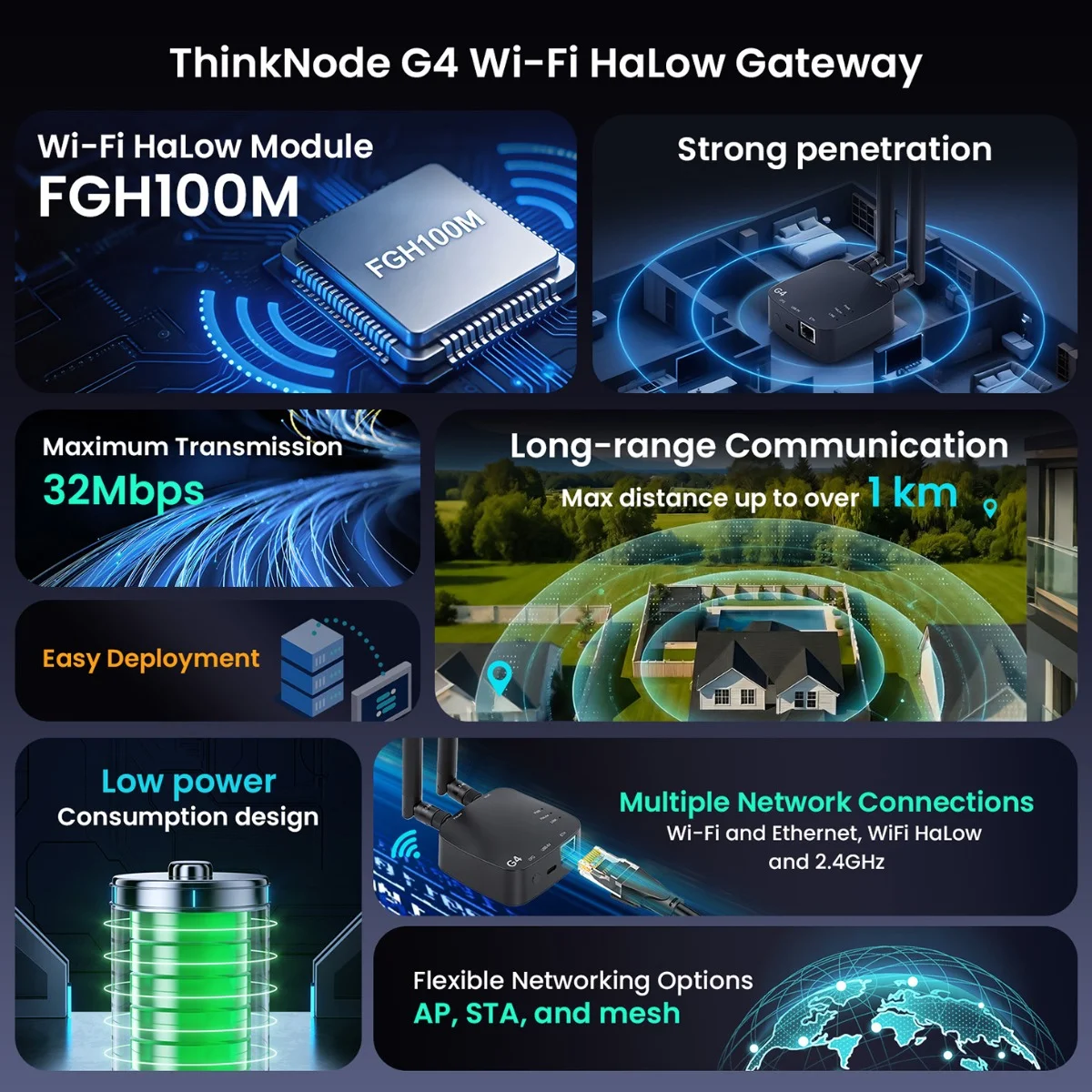
Figure 6: Elecrow ThinkNode G4 — Dual-band HaLow + 2.4 GHz Wi-Fi gateway with Ethernet backhaul, Web UI management, and AP/STA/Mesh flexibility.
Built around the FGH100M HaLow chip, the ThinkNode G4 features a dual-band design (Sub-1 GHz HaLow + 2.4 GHz Wi-Fi) plus a dedicated Ethernet port, allowing it to bridge HaLow sensor networks seamlessly into existing IP infrastructure. Key specifications include:
- Data rate: Up to 32 Mbps — sufficient for multi-channel video backhaul and bulk sensor data
- Range: 1 km+ (up to 1–2 km in open environments) with strong wall and vegetation penetration
- Networking modes: AP, STA, and Mesh — deploy as a central access point, a remote client bridge, or mesh-extended coverage
- Management: Built-in Web UI for zero-code configuration, plus OTA firmware upgrades
- Power: USB-C 5 V supply, low-power design suitable for solar/battery off-grid deployments
- Customization: Designed and manufactured by Elecrow; OEM/ODM and white-label options available based on MOQ
Typical use cases include smart farm sensor hubs (one G4 in the barn covers the entire field), remote camera monitoring (HaLow backhaul from outdoor cameras to the G4, then Ethernet to NVR), rural broadband relay (G4 as a STA client on a distant HaLow AP, bridging to local Wi-Fi), and industrial automation (mesh network of G4 units across a factory floor). For makers who have outgrown single-board experiments and need a drop-in HaLow infrastructure component, the ThinkNode G4 is currently one of the most cost-effective and feature-complete options on the market.
For makers, the Elecrow ESP32 HaLow Camera Module is currently the most accessible entry point — it supports the familiar Arduino IDE, integrates 2.4 GHz Wi-Fi (for local debugging), Bluetooth 5.0, and HaLow tri-mode wireless, and includes a 2 MP camera and SD card slot. While the ESP32 itself does not natively speak HaLow (the FGH100M companion chip handles HaLow protocol), this design lets you leverage the vast ESP32 ecosystem for rapid application development.
5.3 The Global Spectrum Fragmentation Challenge
An important yet often overlooked issue is HaLow's global spectrum fragmentation. While Sub-1 GHz is unlicensed ISM band in most countries, specific frequency ranges, power limits, and duty-cycle rules vary dramatically:
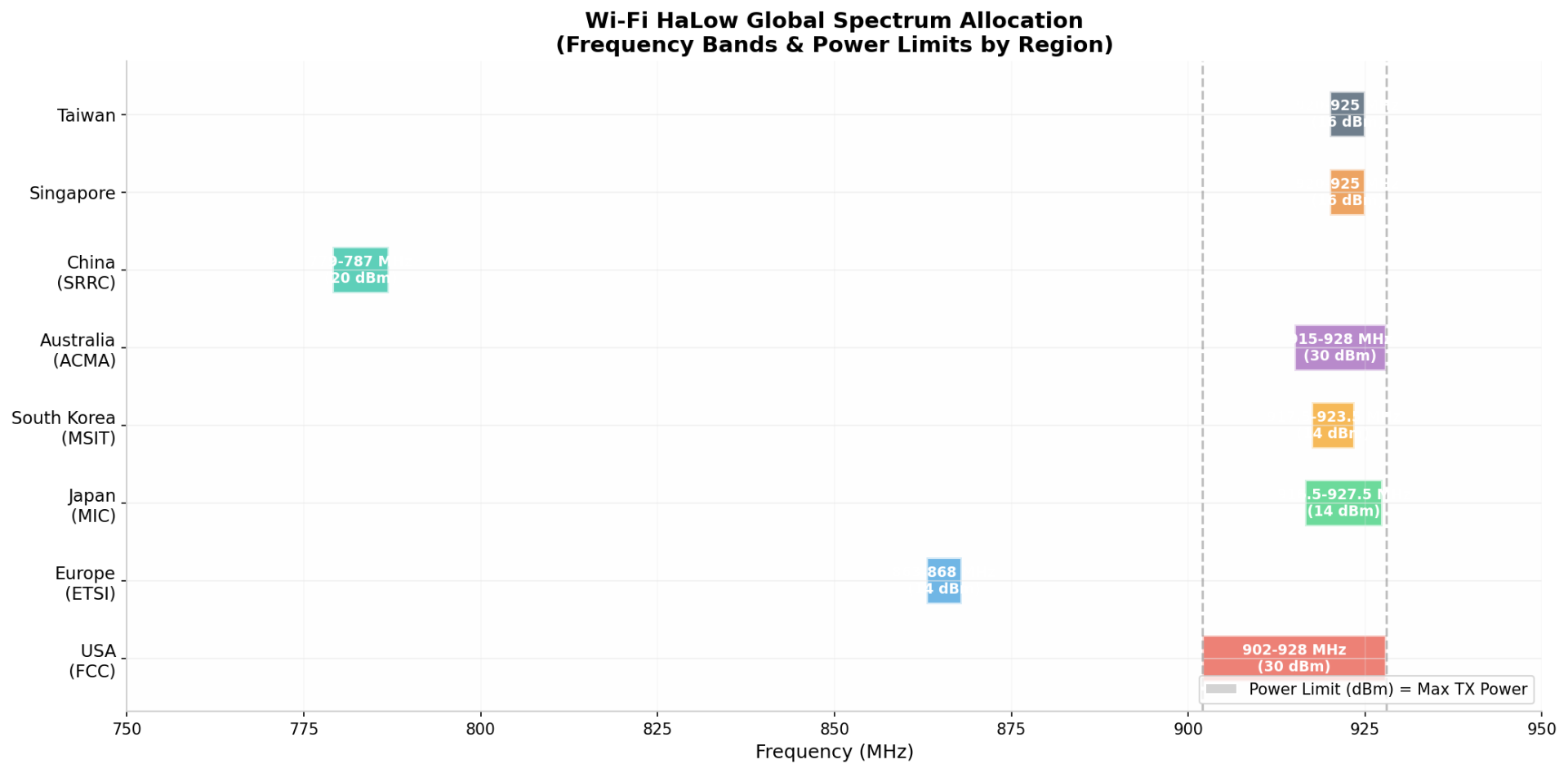
Figure 4: Global Wi-Fi HaLow Spectrum Allocation — Frequency bands and maximum TX power vary significantly by region.
| Region | Frequency Range | Max Power | Duty Cycle | Notes |
|---|---|---|---|---|
| USA (FCC) | 902 – 928 MHz | 30 dBm (1 W) | Unlimited | Most permissive regulatory environment; full 1/2/4/8 MHz support |
| EU (ETSI) | 863 – 868 MHz | 14 dBm (25 mW) | 0.1% – 10% | Power is 1/40 of USA; strict duty-cycle management required |
| Japan (MIC) | 916.5 – 927.5 MHz | 14 dBm | LBT required | Listen-before-talk mandatory |
| South Korea (MSIT) | 917.5 – 923.5 MHz | 14 dBm | Spectrum etiquette | Partial sub-band restrictions |
| Australia (ACMA) | 915 – 928 MHz | 30 dBm | No strict limit | Similar to USA |
| China (SRRC) | 779 – 787 MHz | TBD | TBD | Still in regulatory planning |
For globally marketed products, this means regional variants or wideband programmable chips (850–950 MHz) are necessary. Both Morse Micro and Newracom's latest generations support global Sub-1 GHz band programmability, but developers must still complete regional RF certifications (FCC, CE, MIC, KC, SRRC, etc.) — each with non-trivial testing costs and lead times.
6. Market Outlook: Why Now Is the Time
6.1 Explosive Growth Forecasts
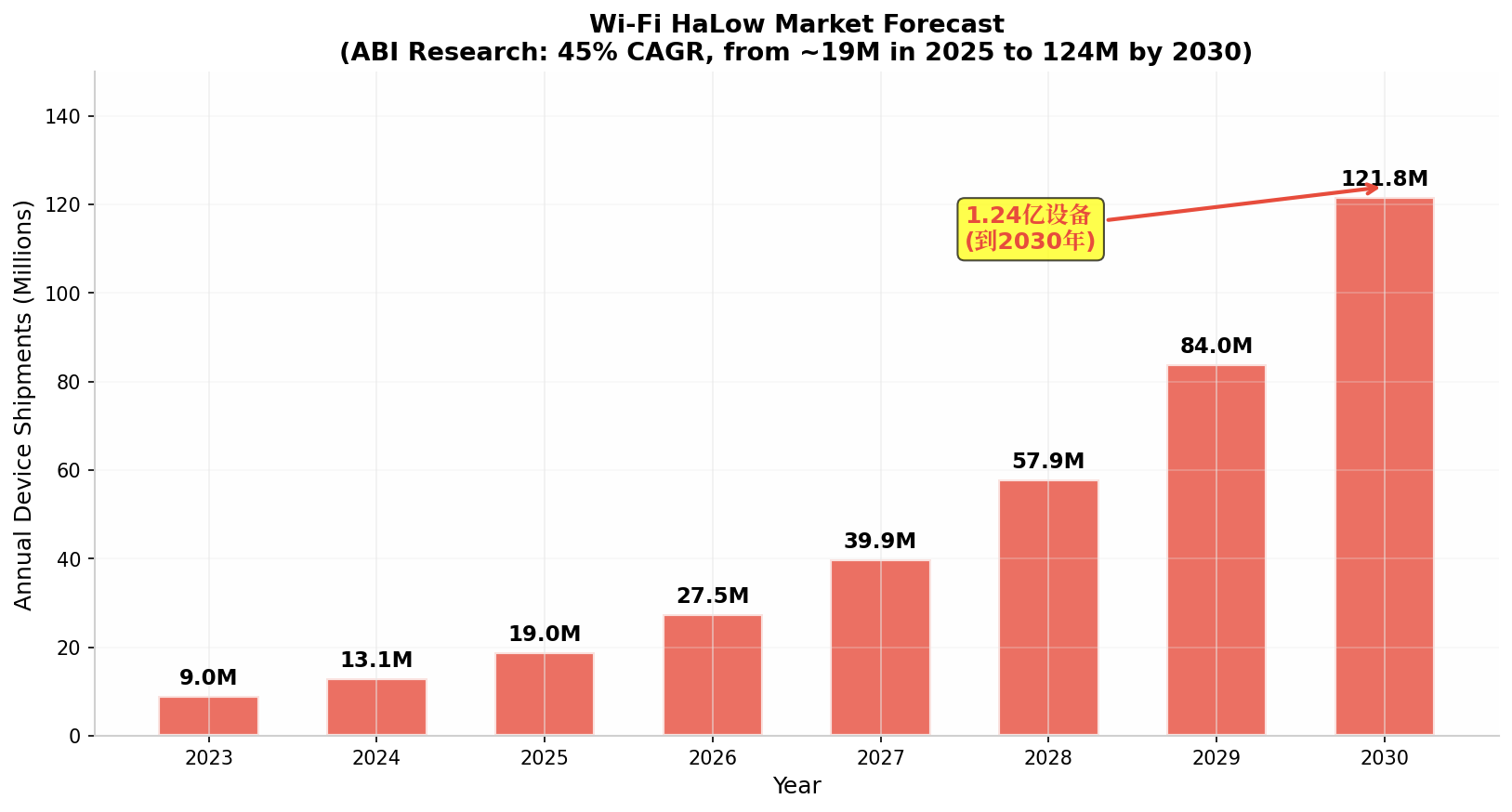
Figure 5: ABI Research Forecast — Wi-Fi HaLow device shipments growing from ~19M in 2025 to 124M by 2030.
Multiple research firms have issued strongly optimistic projections for Wi-Fi HaLow. Omdia's Wi-Fi HaLow (802.11ah) Market Assessment forecasts 79% CAGR through 2029. ABI Research predicts over 124 million Wi-Fi HaLow devices in use by 2030, with annual shipments rising from ~19 million in 2025 to 124 million in 2030 (45% CAGR) — the highest growth rate among all wireless connectivity technologies. IndustryARC offers a more conservative yet still impressive outlook: HaLow device market size growing from its 2023 baseline to $1.5 billion by 2030, at 37.4% CAGR.
Geographically, Asia-Pacific is expected to capture the largest share (~42.3%), driven by China's smart manufacturing ecosystem and smart city investments. North America follows at 24.8%, benefiting from early industrial IoT and smart home adoption.
6.2 Adoption Timeline: From Industrial to Consumer
| Phase | Period | Primary Applications | Drivers |
|---|---|---|---|
| Phase 1 | 2024–2025 | Industrial video surveillance, security cameras, automation | High-bandwidth IP camera demand in industrial settings |
| Phase 2 | 2026–2027 | Smart home security cameras, doorbells, drones | Consumer HaLow chip volume production, cost reduction |
| Phase 3 | 2027–2028 | Smart cities, smart meters, traffic sensors | City-scale infrastructure deployment, policy push |
| Phase 4 | 2028+ | Mass IoT 2.0, edge AI, holographic sensing | Mature infrastructure, new application emergence |
Omdia's Andrew Brown specifically highlights video transmission as HaLow's critical beachhead. Among common low-power wireless standards, only LTE-M can also carry video, but its bandwidth limits restrict it to mid-to-low resolution. HaLow's unique advantage in video will drive the first wave of infrastructure deployment; once that infrastructure exists, non-video applications such as sensors, actuators, and lighting will naturally follow.
6.3 What This Means for Makers
For the maker community, HaLow is currently in the "early adopter" phase. Module prices remain high relative to ESP32 + LoRa combinations, the toolchain is still maturing, and native Arduino/PlatformIO support is not yet complete. But this is precisely the technology dividend window — developers who build expertise now, while the ecosystem is forming, will be positioned ahead of the curve when consumer HaLow chips hit volume production in 2026–2027.
Elecrow's ESP32 HaLow module is an excellent entry point — it brings HaLow functionality into the maker-accessible $40–$50 price bracket, paired with the familiar Arduino ecosystem and a 2 MP camera, sufficient for a wide range of proof-of-concept projects.
7. Getting Started & Resource Roundup
7.1 Recommended Learning Roadmap
| Stage | Recommended Hardware | Budget | Learning Focus |
|---|---|---|---|
| Stage 1: Explore | Elecrow ESP32 HaLow Camera | $30–$50 | Arduino development, HaLow AP/STA modes, basic range testing |
| Stage 2: Prototype | Alfa Network NRC7292 MikroBus + custom baseboard, or Elecrow ThinkNode G4 for gateway testing | $50–$150 | Linux drivers, IP networking, TWT power optimization, gateway mesh topology |
| Stage 3: Product | Morse Micro MM6108 module + custom PCB | $200–$500 | RF design, certification process, production optimization |
7.2 Key References
- Wi-Fi Alliance HaLow Technology Whitepaper: Wi-Fi CERTIFIED HaLow Technology Overview
- WBA HaLow for IoT Field Trials Report: Wi-Fi HaLow for IoT: Field Trials Report
- Morse Micro Technical Docs & Eval Kits: morsemicro.com/technology
7.3 Frequently Asked Questions
Q: Can HaLow work with my existing Wi-Fi router?
A: Not directly. HaLow requires a dedicated HaLow AP (or gateway), but you can connect the HaLow AP via Ethernet to your existing router for network convergence. The Elecrow ThinkNode G4 is designed exactly for this — it acts as a HaLow AP/STA while providing Ethernet and 2.4 GHz Wi-Fi bridge ports, letting you drop it into any existing network without replacing your current router. Future tri-band routers (2.4 + 5 + HaLow) will support this natively.
Q: What is HaLow's latency? Can it be used for real-time control?
A: HaLow latency is in the millisecond range (typically 10–100 ms), far better than LoRaWAN's second-to-minute scale. It is sufficient for most industrial control and smart home scenarios, though not as fast as traditional Wi-Fi's sub-millisecond latency for extreme cases like competitive gaming.
Q: How strong is HaLow's wall penetration, really?
A: Per Ofcom building-material propagation reports, 900 MHz signal attenuation through brick walls is roughly one-third that of 2.4 GHz. Silex measured HaLow maintaining -74 dBm RSSI after penetrating multiple walls, while 2.4 GHz signal at the same location had disappeared entirely.
Conclusion: Will HaLow Be IoT's "Next Big Thing"?
Wi-Fi HaLow likely sits at a stage similar to where Wi-Fi (802.11b/g) was in the early 2000s — the technical standard is mature, the ecosystem is forming, the killer application (video transmission) has emerged, and the cost curve is descending rapidly. For makers, DIY enthusiasts, and radio amateurs, HaLow offers a unique opportunity: it combines Wi-Fi's open standards and IP-native convenience with Sub-1 GHz's long-range and wall-penetration capabilities, while still being able to transmit video and images when needed — something impossible or extremely difficult with LoRaWAN, Zigbee, or BLE.
Of course, HaLow is not a silver bullet. Its power consumption remains higher than LoRaWAN for ultra-sparse transmission scenarios, ecosystem maturity still trails traditional Wi-Fi, and global spectrum fragmentation adds product development complexity. But these "imperfections" are precisely what create the early-adopter opportunity window — once all problems are solved, the barrier to entry will rise accordingly.
If you are planning a project that demands kilometer-scale coverage + video/image transmission + unlicensed spectrum + standard IP networking, now is the best time to start exploring Wi-Fi HaLow. Starting with our new product, you may just open the door to an entirely new world of wireless applications.
Ready to Build?
Grab an Elecrow ESP32 HaLow Camera ($42) for quick prototyping, or deploy a ThinkNode G4 Gateway ($54) for real-world infrastructure, and test how far your Sub-1 GHz signal can reach. Share your range records and project builds — the HaLow maker community is just getting started.


