Currency
Toggle Nav

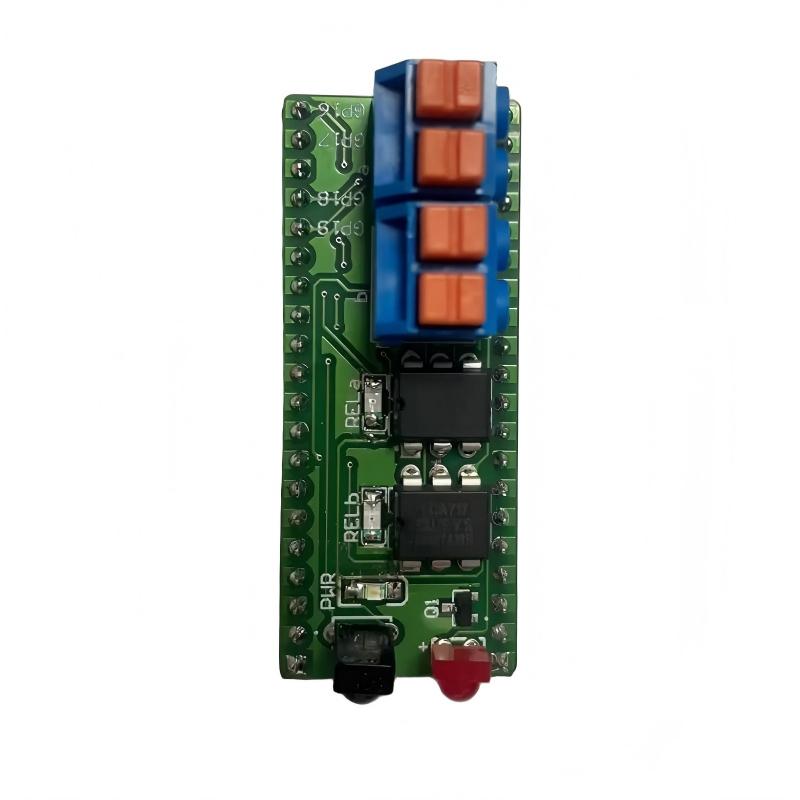


IR 38 kHz Remote Relay Switch for RASPBERRY PI PICO
$30.00
Availability:
In stock
SKU
CQA231107RR
Weight
47g
Related Products:





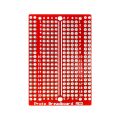
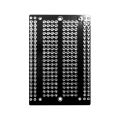

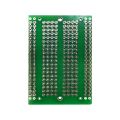

IR 38 kHz Remote Relay Switch for RASPBERRYPI PICO and PICO2
Frequently Bought Together

Meteor Screen 10.1" IPS Capacitive Touch Screen with RGB Animated light
was
$89.90
Special Price
$70.12

IR 38 kHz Remote Relay Switch for RASPBERRYPI PICO and PICO2
IR 38 kHz Remote Relay Switch for Raspberry Pi Pico and Pico2 is a compact and flexible remote switching solution designed for wireless control of isolated outputs using standard infrared remote controllers. The design is based on the Raspberry Pi and compatible with both Raspberry Pi Pico and Pico2 platforms, using a 38 kHz infrared receiver such as the TSOP38238 for signal detection and decoding.
The system receives and decodes commands from standard 38 kHz infrared remote controls, including remotes using the widely supported NEC protocol, which has been verified for reliable operation in this design. It can also be used with smartphones equipped with an integrated IR transmitter (IR blaster), enabling direct control via mobile applications. Button commands from the remote or smartphone can be assigned in software to independently switch isolated outputs on or off, making the module suitable for wireless control, signal triggering, and remote activation applications.
Output switching is implemented using two LCA717 solid-state relays, providing electrically isolated control channels driven directly from Raspberry Pi Pico GPIO pins. Each channel can be independently toggled by specific remote-control buttons, enabling dual-channel remote switching without mechanical relay wear, contact bounce, or acoustic noise.
An additional transistor-driven indicator stage based on the BC846B provides optional visual feedback for received IR commands or output state indication. This can be configured in software as a pulse-detection indicator or as a status LED, improving usability during testing and operation.
The design has been verified against the schematics to ensure correct signal routing, reliable IR reception, proper GPIO control of the OptoMOS relays, and stable operation with common NEC-compatible remote controllers. Particular attention has been given to input conditioning, GPIO protection, and isolated output switching behavior.
MicroPython example programs are available for Raspberry Pi Pico/Pico2, allowing users to quickly implement remote button detection, NEC code decoding, relay toggling, and custom remote-command mapping. This makes the module suitable for prototyping, home automation, remote sensor triggering, industrial control interfaces, and embedded wireless switching applications.
Features
- Based on 38 kHz infrared reception using TSOP38238
- Compatible with Raspberry Pi and Raspberry Pi Pico2 platforms
- Supports standard IR remote controls using the NEC protocol
- Verified operation with common 38 kHz consumer remote controllers
- Compatible with smartphones equipped with IR transmitters (IR blaster) for direct control
- Two independent isolated outputs using LCA717 solid-state relays
- Remote-controlled ON/OFF switching of two separate output channels
- Electrical isolation between GPIO control and switched load outputs
- Silent solid-state switching without mechanical relay wear or contact bounce
- Optional transistor-driven receive/status indicator using BC846B
- Programmable remote button assignment for custom switching functions
- MicroPython example code available for IR decoding and relay control
- Verified schematic design for reliable operation
- Suitable for remote switching, sensor triggering, automation, and embedded control applications
Applications
- Remote switching of sensors, signals, and isolated control inputs
- Wireless control for home automation and smart switching projects
- Remote triggering for embedded systems and microcontroller applications
- Industrial control interfaces using isolated solid-state relay outputs
- PLC input simulation and remote signal activation
- Sensor enable/disable control in test and measurement systems
- Infrared-controlled switching for low-voltage automation projects
- Educational and prototyping applications using IR communication and relay control
- DIY remote-control projects using NEC-compatible infrared remotes
- Status signaling and remote actuation in IoT systems
- Contactless switching applications where mechanical relays are not desired
- Remote control interfaces for custom electronic and embedded designs
Technical Specifications
- IR Receiver Type: TSOP38238 38 kHz demodulating receiver
- Supported IR Frequency: 38 kHz
- Supported Remote Protocol: NEC compatible (verified operation)
- Controller Platform: Raspberry Pi and Raspberry Pi Pico2
- Logic Level: 3.3 V GPIO compatible
- Supply Voltage (Controller): 3.3 V DC
- Number of Control Channels: 2 independent isolated outputs
- Output Switching Device: LCA717 solid-state relay
- Relay Configuration: SPST-NO (1 Form A)
- Maximum Load Voltage: 30 V
- Continuous Load Current: up to 2 A per channel
- Peak Load Current: up to 5 A (10 ms)
- Low On-State Resistance: 0.083 Ω typical (0.15 Ω max)
- Off-State Leakage Current: 1 µA maximum
- High Isolation Voltage: 3750 Vrms input-to-output isolation
- Relay Input Drive Current: 2 mA maximum activation current
- Input Current Limiting: 280 Ω series resistor (typical)
- Output Function: Independent ON/OFF toggling via remote control
- Relay Switching Time: 0.92 ms typ. turn-on, 0.44 ms typ. turn-off
- IR Signal Processing: Software decoding via MicroPython
- Command Response Time: typically, <100 ms
- Optional Receive/Status Indicator: BC846B transistor stage
- Operating Temperature Range: −40 °C to +85 °C (relay device)
- Control Method: Compatible with MicroPython and other GPIO-capable platforms
- Verified schematic design for reliable IR reception, isolated switching, and stable operation
- Suitable for low-voltage automation, signal routing, sensor switching, and embedded control applications
Additional Notes and Information
To run the provided MicroPython example for the IR 38 kHz Remote Relay Switch board, install and use the Thonny IDE with your Raspberry Pi or Pico2.
1. Install Thonny IDE on your computer.
2. Connect the Raspberry Pi Pico to the PC using a USB cable.
3. In Thonny, select MicroPython (Raspberry Pi Pico) as the interpreter.
4. Open the provided `main.py` example file.
5. Save the file to the Raspberry Pi Pico (File → Save As → Raspberry Pi Pico).
6. Press Run (F5) or restart the board.
After uploading, the `main.py` file will automatically execute on every board reset. The program initializes the 38 kHz infrared receiver, decodes commands from NEC-compatible remote controllers, and enables remote control of the two isolated outputs through the LCA717 channels.
For reliable operation, use a standard 38 kHz IR remote control and ensure the IR receiver (for example TSOP38238) has a clear line-of-sight to the transmitter. Remote button codes can be identified using the included MicroPython IR reader example and assigned in software to custom switching functions.
The example code supports independent relay toggling, receive-indicator signaling, and custom remote-button mapping. This allows immediate functional verification after startup and simplifies integration into automation, switching, and embedded control applications.
Downloads
- main.py
- schematics.JPG
Write Your Own Review
Bestselling Products You May Like


New Products You May Want

Warranty
Service

VIP Distributor
Discount

Professional
Tech Support

Fast
Delivery
×
 Add to cart successfully!


Add to cart successfully!
Customers Who View This Item Also Bought