Choosing the right ESP32 microcontroller can make or break your IoT product. In 2026, Espressif offers three compelling options — the proven ESP32-S3, the all-new ESP32-S31, and the multimedia powerhouse ESP32-P4. But which one actually fits your project?
If you are building a smart HMI display, a Matter gateway, or an edge AI camera, the wrong chip means bloated BOM costs, slower time-to-market, and compromised performance. In this guide, we compare the ESP32-S31 vs S3 vs P4 across 14 technical dimensions and 6 real-world application scenarios — all verified by Espressif's official demo projects.
Table of Contents
Which Chip Should You Pick?
ESP32-S31 is not a downgraded P4, nor a simple S3 upgrade. It is the only "sweet spot" in Espressif's lineup that delivers full-protocol wireless + capable multimedia + official module availability. The P4 is a wireless-less high-performance multimedia MCU. The S3 is the proven all-rounder. The S31 fills the gap: single-chip Matter gateways, fluid HMI, edge AI, and classic Bluetooth audio — without the external wireless coprocessor the P4 demands.
One-Sentence Chip Positioning
ESP32-S3
The Proven All-RounderWi-Fi 4 + BLE 5.0, Xtensa dual-core 240 MHz. Most mature ecosystem, lowest price, minimal mass-production risk. Ideal for validated IoT projects and cost-sensitive scenarios.
ESP32-S31
Full-Protocol Wireless HubWi-Fi 6 + full Bluetooth + Thread/Zigbee + Gigabit Ethernet, RISC-V dual-core 320 MHz. Six official demos validated. For next-gen products demanding connectivity + multimedia + AI with reduced BOM complexity.
ESP32-P4
Wireless-less Multimedia FlagshipDual-core RISC-V 400 MHz + LP-Core 40 MHz, 768 KB SRAM, MIPI-CSI/DSI + H.264 encoding (1080p@30fps). No built-in wireless — must attach ESP32-C6. For extreme video codec and display demands.
Side-by-Side Parameter Comparison
This table translates every spec difference into actionable design decisions for product managers and hardware engineers.
| Dimension | ESP32-S3 | ESP32-S31 | ESP32-P4 |
|---|---|---|---|
| Wireless | Wi-Fi 4 + BLE 5.0 | Wi-Fi 6 + BLE 5.4 + BR/EDR + 802.15.4 | ✗ None (needs external C6) |
| CPU | Xtensa 240 MHz ~1,330 CoreMark |
RISC-V 320 MHz ~2,195 CoreMark |
RISC-V 400 MHz ~2,491 CoreMark |
| Low Power | ULP coprocessor | Limited | LP-Core 40 MHz + 32 KB SRAM |
| SRAM | 512 KB | 512 KB | 768 KB + 8 KB TCM |
| Camera | DVP parallel | DVP parallel (8–16 bit) | MIPI-CSI + ISP + DVP |
| Display | Parallel RGB / I8080 | Parallel RGB / I8080 / MOT06800 | MIPI-DSI + Parallel RGB up to 1080p |
| Video Codec | Software JPEG | Hardware JPEG | H.264 1080p@30 + JPEG 1080p@40 |
| 2D Acceleration | ✗ None | ✓ PPA + 2D-DMA | ✓ PPA + 2D-DMA |
| GPIO | 45 | 60 (most in Espressif lineup) | 55 |
| Ethernet | ✗ None | ✓ Gigabit MAC | ✓ RMII / RGMII |
| USB | Full-speed 12 Mbps | High-speed 480 Mbps OTG | High-speed 480 Mbps OTG |
| Audio | BLE only, no DAC | LE Audio + BR/EDR + 2×DAC | 3×I2S + PDM, no Bluetooth audio |
| Touch | Basic capacitive | 14-ch next-gen (proximity / water / glove) | Capacitive touch (prev-gen) |
| Security | Secure boot + encryption | + TEE + PUF + anti side-channel | + Digital signature + KMU |
| Modules | ✓ Mass stock | ✓ Released for procurement | Pre-production samples only |
S31 vs P4: The Real Difference
Many see both chips as RISC-V dual-core with PPA + 2D-DMA, high-speed USB, and Ethernet — assuming S31 is "P4 with wireless" or P4 is "S31 high-performance." This is wrong. Their design goals diverge across three core dimensions:
1. Wireless: S31 "Brings Its Own"; P4 "Must Attach"
The ESP32-P4 has zero built-in RF — no Wi-Fi, no Bluetooth, no 802.15.4. Espressif's official recommendation is attaching an ESP32-C6 module via SPI/SDIO/UART, using ESP-Hosted or ESP-AT stack.
This means the P4 solution requires:
- Extra C6 module purchase (~$2–3), raising BOM cost
- PCB routing for two chips and more complex antenna design
- Split software stack: P4 main program + C6 coprocessor firmware
- Coordinated power management across two chips
The ESP32-S31 completes all wireless protocols in a single chip, with a unified ESP-IDF stack, single-chip antenna design, and single PMU coordination. For consumer products needing standalone networking, S31's integration is a crushing advantage.
2. Multimedia: P4 Is "Pro-Grade"; S31 Is "Practical-Grade"
The ESP32-P4 features MIPI-CSI/DSI interfaces and H.264 hardware encoding (1080p@30fps) — mandatory for IP cameras, video doorbells, and dashcams. The ESP32-S31 only offers DVP parallel camera and RGB parallel display interfaces with MJPEG codec.
But here is the critical question: do most IoT products actually need 1080p H.264?
- Smart control panels: 720p is sufficient; S31 RGB + PPA fully handles it
- Camera-equipped smart locks: 3MP DVP + MJPEG streaming is enough for face recognition
- Industrial HMI: 480p–720p is mainstream; S31 hardware JPEG encoding uses zero CPU
Only IP cameras, dashcams, and HD video doorbells truly need the P4's H.264 + MIPI combo.
3. Performance: P4 Higher Peak; S31 Higher Per-MHz Efficiency
P4 clocks at 400 MHz (shipping ~360 MHz) with ~2,491 CoreMark. S31 clocks at 320 MHz with ~2,195 CoreMark. P4's absolute performance is ~13% higher, but S31's CoreMark/MHz reaches 6.86, exceeding P4's 6.23 — meaning S31's RISC-V core is more efficient at the same frequency, thanks to newer microarchitecture optimizations.
Additionally, P4's unique LP-Core (40 MHz low-power subsystem) can independently run sensor acquisition while the main core sleeps — a major win for battery-powered devices. S31 currently lacks this independent low-power subsystem.
If your product needs standalone networking and video ≤720p — choose ESP32-S31. Its integration, BOM cost, and development complexity are far lower than P4+C6.
If your product needs 1080p H.264, MIPI camera/display, and already has an independent wireless solution — choose ESP32-P4. Its multimedia performance and LP-Core are irreplaceable.
6 Real-World Application Scenarios
Multi-Protocol Matter Gateway
Espressif's official multi-protocol gateway demo validates S31 running Wi-Fi 6 + Thread + Zigbee + Bluetooth 5.4 in a single chip. This is a scenario P4 cannot complete independently — P4 lacks 802.15.4 RF and Wi-Fi, requiring an external C6 module just to act as a Matter Border Router.
With S31, one module plus a Gigabit PHY equals a complete Matter Border Router + wired backhaul gateway. P4+C6 still cannot support classic Bluetooth BR/EDR, and coordinating two protocol stacks increases software complexity.
Real products: Apartment smart control panels, screen-equipped Matter gateways, PoE industrial protocol converters, Modbus TCP data nodes.
HMI Multimedia Displays
Korvo-1 (S31) and P4-Function-EV-Board represent two HMI philosophies. Korvo-1 validates fluid interaction below 720p with DVP + parallel RGB; P4-EV-Board validates 1080p HD with MIPI-DSI.
For smart control panels, 86-box controllers, and industrial HMI at 720p and below, S31's hardware PPA + 2D-DMA + DVP camera is fully sufficient, and built-in wireless enables direct networking. Only when 1080p HD video compression is needed (IP cameras, premium video doorbells) does P4's H.264 + MIPI become mandatory.
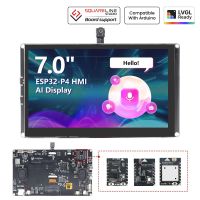
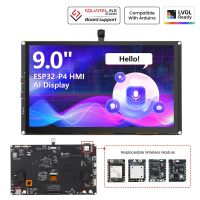
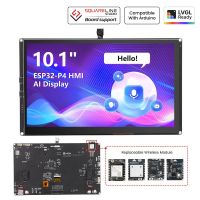
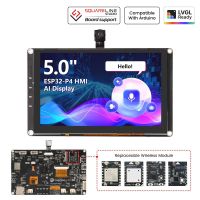
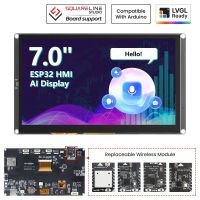
Looking for ready-made HMI hardware? Check out our ESP32-S3 HMI Display Advance Series for proven, cost-effective smart screens, or explore the ESP32-P4 HMI Display Series for 1080p multimedia applications.
Edge AI Vision
P4 leads in raw compute (400 MHz + 768 KB SRAM + AI vector extensions). But S31's built-in wireless gives it the edge in "edge inference + cloud linkage" scenarios.
Per official ESP-VoCat benchmarks, on YOLO11n (640×640), S31 inference time drops from S3's 26,057 ms to 8,701 ms — roughly 1/3 of S3. On ESPDet-Pico (224×224), S31 hits ~11 FPS, a 28% improvement over S3.
The community has already built a local digital human on Korvo-1 — fully embedded AI inference + voice interaction. Without external C6, P4's digital human cannot fetch weather or news. S31's single-chip solution makes "edge AI + networking" one unified whole.
Real products: Offline smart lock (S31, face + liveness), children's companion robot (S31), production line QC camera (P4, high-speed defect detection).
LE Audio & Classic Bluetooth
P4 has zero Bluetooth RF. It cannot support LE Audio or classic Bluetooth BR/EDR. Even with external C6, C6 only supports Wi-Fi 6 + 802.15.4 + BLE — not classic Bluetooth.
S31 covers the full audio ecosystem: Bluetooth 5.4 LE Audio (LC3 codec, multi-stream) + classic Bluetooth BR/EDR + dual I2S + hardware ASRC + onboard DAC. For any Bluetooth audio product — smart speakers, car adapters, wireless headphone repeaters, USB sound cards — S31 is the only choice within Espressif's lineup that can be completed independently.
USB Peripherals
Both support USB 2.0 high-speed OTG (480 Mbps) and can function as UVC cameras, USB sound cards, USB network adapters, or mass storage devices. S3 is eliminated here with its full-speed 12 Mbps bottleneck.
However, S31's built-in wireless lets a USB device simultaneously become a wireless device (e.g., wireless + USB dual-mode camera). P4 requires external C6 for wireless functionality.
Next-Generation Touch Sensor
S31 integrates Espressif's latest capacitive touch sensor with 14 channels, proximity sensing, water rejection, and glove mode. P4 uses the previous generation, with high false-touch rates in humid or gloved environments. S3 often requires external touch chips like GT911.
Real products: Kitchen smart panels, bathroom mirror controls, industrial glove-operated terminals, outdoor smart locks, car control knobs.
Elecrow ESP32 HMI Display Solutions
Whether you choose the proven ESP32-S3 for cost-sensitive HMI projects or the cutting-edge ESP32-P4 for 1080p multimedia, Elecrow has the display hardware to match your chip selection.
ESP32-S3 HMI Display
Proven, cost-effective smart displays with capacitive touch, Wi-Fi 4, and BLE 5.0. Ideal for industrial panels, smart home controllers, and retail kiosks.
Explore S3 Series →ESP32-P4 HMI Display
Next-gen 1080p multimedia displays with MIPI-DSI, H.264 encoding, and AI acceleration. Built for high-definition video doorbells, dashcams, and premium control panels.
Explore P4 Series →1-Minute Decision Tree
Answer these 6 questions to find your optimal chip in under 60 seconds.
If no → Consider P4 (or check performance needs)
If no → Continue to Q3
If 720p and below is sufficient → Continue to Q4
If no → Continue to Q5
If no → Continue to Q6
If no → Choose S31 (better long-term platform, official modules ready)
Ecosystem & Mass-Production Readiness
ESP32-S31 Ecosystem
- ESP-IDF master branch fully supported (requires
--previewflag) - ESP-Matter, ESP-GMF, ESP-BLE-AUDIO, ESP-SR all ready
- Online flashing tool + AI Assistant lower the barrier to entry
- ⚠️ Arduino-ESP32 and MicroPython not yet officially supported
- ✅ Official modules released, ready for mass procurement
ESP32-P4 Ecosystem
- ESP-IDF supported, but chip remains in pre-production sample stage
- ESP-Hosted / ESP-AT for attaching C6 to achieve wireless
- ⚠️ Some final features may adjust in mass production
- ⚠️ No official modules yet; primarily supplied as dev boards
ESP32-S3 Ecosystem
- ESP-IDF, Arduino, MicroPython, PlatformIO — fully mature
- Modules in abundant stock, lowest price, most stable supply chain
- Richest community resources and third-party library support
- Ideal for projects already in mass production or budget-sensitive