








Story
Introduction
While exploring different IoT-based environmental monitoring solutions, I came across an interesting concept of a compact weather monitoring system using ESP32 and the BME280 sensor. The idea of creating a low-power, real-time monitoring device capable of measuring environmental conditions caught my attention. As a developer, I decided to implement this project with improvements in stability, accuracy, and usability, making it suitable for real-world deployment.
Project Overview
This project is designed to measure and display environmental parameters such as temperature, humidity, and atmospheric pressure using the BME280 sensor. The ESP32 microcontroller acts as the core processing unit due to its built-in Wi-Fi capability and efficient power management features.
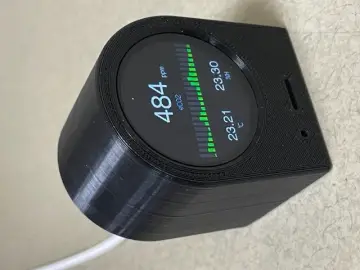
The system collects sensor data and displays it on an OLED screen in real time. Additionally, it hosts a lightweight web server, allowing users to monitor environmental data remotely through a browser. The device is compact, making it ideal for both indoor and outdoor monitoring applications.
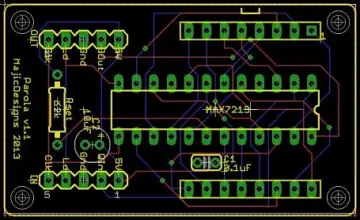
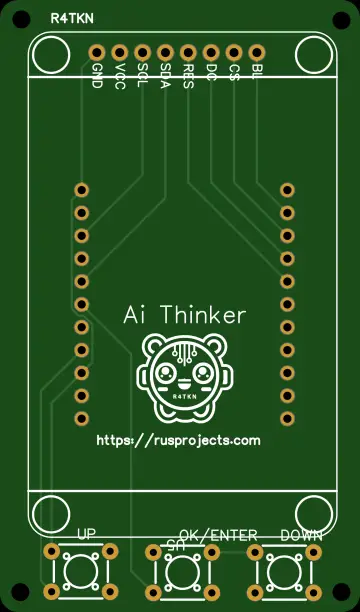
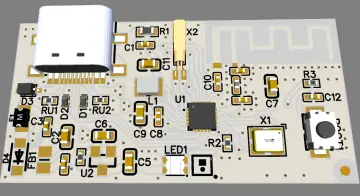
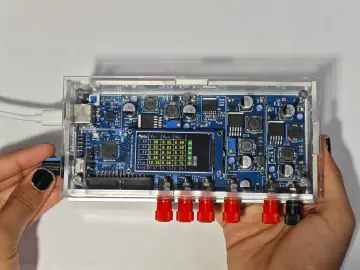
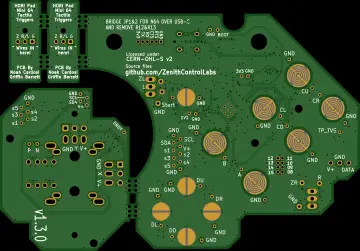
The PCB was carefully designed to ensure proper routing, minimal noise interference, and stable power delivery to all components. Special attention was given to sensor placement to avoid heat influence from the ESP32, ensuring accurate readings.
Development Process
The development process began with selecting suitable components and designing the circuit. The ESP32 was chosen for its versatility and strong community support, while the BME280 sensor was selected for its high accuracy and reliability.
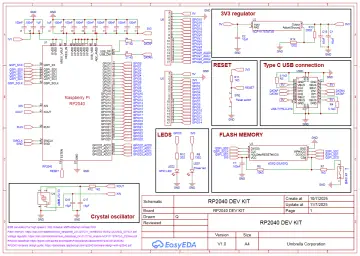
After designing the schematic, I moved on to PCB layout design. Proper grounding and trace optimization were implemented to reduce signal noise. Once the design was finalized, the PCB was fabricated and assembled.
The firmware was developed using Arduino IDE, where sensor data was read using I2C communication. The collected data was processed and displayed on the OLED screen while also being sent to a web interface for remote access.
Challenges Faced
During the development of this project, several technical challenges were encountered.
The first challenge was sensor calibration. The BME280 sensor is sensitive to environmental variations, and initial readings were inconsistent. To fix this, I implemented calibration techniques and added software-level compensation to stabilize the readings.
Another major issue was Wi-Fi connectivity stability. The ESP32 occasionally disconnected from the network, which affected real-time monitoring. This was resolved by implementing an auto-reconnect mechanism and optimizing network handling in the firmware.
Power management was also a concern, especially when running the system continuously. I optimized the code to reduce unnecessary processing and implemented sleep cycles where possible, improving overall efficiency.
Integrating the OLED display without causing delays was another challenge. Continuous data updates were causing flickering and lag. I solved this by optimizing display refresh intervals and updating only changed values instead of refreshing the entire screen.
Final Implementation
After addressing all challenges, the system performed reliably and delivered accurate real-time data. The final device was compact, efficient, and suitable for practical use cases such as home automation, weather tracking, and environmental monitoring.
The PCB design ensured durability and clean signal transmission, while the optimized firmware provided stable performance over long durations. The addition of a web interface significantly enhanced usability by allowing remote monitoring.
This project demonstrates how IoT and embedded systems can be combined to build efficient, real-world solutions. It also highlights the importance of proper hardware design and firmware optimization in achieving reliable performance.
Conclusion
Developing this weather monitoring system was a valuable learning experience that involved both hardware and software challenges. From sensor calibration to network optimization, each stage required careful debugging and improvement. The final outcome is a robust and scalable system that can be further enhanced with cloud integration and data logging features.
Reference: https://digitalmonk.biz/smart-golf-ball