Currency
Toggle Nav

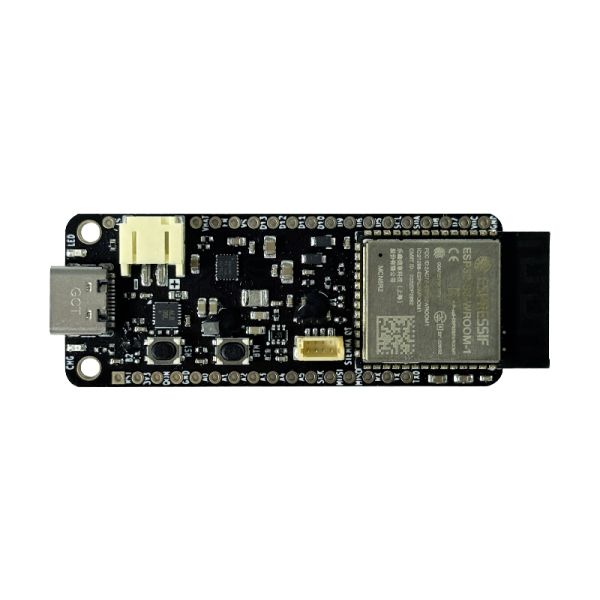


ESP32-S3 PowerFeather V2
$30.00
Availability:
Out of stock
SKU
CQC240319PV2
Weight
55g

Related Products:

ESP32-S3 PowerFeather is a low-power, solar-capable, Feather-compatible ESP32 development board with LiFePO4/LFP, Li-ion, and LiPo battery support.
Frequently Bought Together

ESP32-S3 PowerFeather V2 - Low-Power Solar ESP32 Board with LiFePO4/LFP, Li-ion, and LiPo Support
ESP32-S3 PowerFeather V2 is a low-power, solar-capable, LiFePO4/Li-ion/LiPo-powered IoT development board in a Feather-compatible format. It is perfect for building portable/mobile devices requiring battery power, or devices deployed in remote areas relying on a combination of battery power and off-grid power sources such as solar panels.
Here are a few reasons why you should use ESP32-S3 PowerFeather V2 for your next project:
- Powerful Brains & Connectivity: The board features an Espressif ESP32-S3 module at its core. This module has a speedy dual core processor, tons of flash and RAM, a rich set of peripherals and built-in 2.4 GHz Wi-Fi + Bluetooth LE.
- Low Power: The board's circuitry has been thoughtfully designed and components carefully chosen to minimize quiescent current. Current consumption when the ESP32-S3 is in deep-sleep can be as low as 20 µA, and as low as 1 µA in ship mode and shutdown mode.
- LiFePO4/LFP, Li-ion and LiPo Support: V2 adds support for LiFePO4/LFP batteries alongside Li-ion and LiPo. The Analog Devices MAX17260 fuel gauge provides accurate state-of-charge estimation across all three chemistries, and the TPS631013 buck-boost regulator keeps the 3.3 V rail stable across the full LiFePO4 voltage range.
- Flexible Power Management & Monitoring: The board has a firmware-controllable charger IC, a battery fuel gauge and other hardware/circuitry to give users utmost flexibility in power management and monitoring. The application firmware can enable or disable charging on-demand, set maximum battery charging current, get an estimate of the battery's charge, health, cycle count, time-to-empty and time-to-full, turn off a 3.3 V output rail, and much more!
- Direct Solar Connection: The board accepts an external DC source up to 18 V, which can either be your typical wall wart adapter or a solar panel. If using a solar panel, the maximum power point (MPP) voltage can be set to extract power at near-MPPT effectiveness.
- Extensive Hardware & Software Support: There is an accompanying Arduino and ESP-IDF SDK to give users easy access to the board's power management and monitoring features, including chemistry-aware configuration for LiFePO4/LFP, Li-ion and LiPo. On the hardware side, the board is compatible with hundreds of existing FeatherWing and STEMMA QT modules for faster prototyping.
Features and Specifications
Physical
- Board Dimensions: 65 mm L x 23 mm W x 7 mm H
- Feather-compatible format, FeatherWing support
- Board Features
- USB-C connector
- Two 2.5 mm mounting holes
- Two 1x16 2.54 mm header pin holes
- Thermistor pin hole
- 2-pin JST PH battery connector (Li-ion/LiPo/LiFePO4)
- 4-pin JST SH STEMMA QT connector
- Green user LED
- Red charger status LED
- User button
- Reset button
- On-board PCB antenna
Capabilities
Compute Resources
- 240 MHz Dual-Core Xtensa LX7 Processor
- RISC-V / FSM Ultra Low Power Coprocessor
- 8 MB Quad-SPI Flash
- 2 MB Quad-SPI PSRAM
- 512 KB SRAM
- 16 KB RTC SRAM
Power Management & Monitoring
- Supply Monitoring
- Current measurement
- Voltage measurement
- Good supply detection
- Supply Management
- Set maintained supply voltage (can be used to set MPP voltage)
- Battery Monitoring
- Voltage measurement
- Temperature measurement
- Current measurement (charge/discharge)
- Charge estimation
- Health & cycle count estimation
- Time-to-empty and time-to-full estimation
- Low charge, high/low voltage alarm
- Battery Management
- Enable/disable charging
- Set max charging current
- Others
- 3V3 enable/disable
- VSQT enable/disable
- FeatherWing enable/disable via EN pin
- Power States
- Ship mode
- Shutdown mode
- Power cycle
- Battery Protections
- Undervoltage Detect @2.2 V, Release @2.4 V
- Overvoltage Detect @4.37 V, Release @4.28 V
- Overcurrent protection @3 A
- Trickle charging safety timer @1 hr
- Temperature-based charging current reduction based on JEITA, cutoff at 0 °C and 50 °C
Interfaces
- Radio
- 2.4 GHz Wi-Fi 802.11b/g/n on PCB antenna
- Bluetooth 5 LE + Mesh on PCB antenna
- Connectors
- USB 1.1 Full-Speed OTG on USB-C connector
- I2C on STEMMA QT connector
- Pin Holes
- 23 I/O on the two 1x16 2.54 mm pitch header pin holes
- All digital input and output capable
- All UART, I2C, SPI, I2S, SDIO, PWM, CAN, RMT, Camera, LCD capable
- 6 analog input capable, 5 touch input capable
- 12 RTC capable (deep sleep pin hold, wake-up source)
- Semitec 103AT input on thermistor pin hole
- 23 I/O on the two 1x16 2.54 mm pitch header pin holes
Power
Input
- 5 V, 2 A max on VUSB USB-C connector
- 5 V – 18 V, 2 A max on VDC header pin
- 4.2 V max (Li-ion/LiPo) / 3.6 V max (LiFePO4), 2 A max on BATP and BATN JST PH battery connector
Output
- 3.3 V, 1 A max shared between board, 3V3 header pin and VSQT STEMMA QT connector
- Battery output on VBAT (tracks battery voltage; up to 4.2 V for Li-ion/LiPo or 3.6 V for LiFePO4), 3 A max shared between board and VBAT header pin
- 5 V – 18 V, 2 A max shared between board and VS header pin
Current Consumption
| Power State | Current |
|---|---|
| Deep-Sleep, Fuel Gauge Enabled | 24 µA |
| Deep-Sleep, Fuel Gauge Disabled | 19 µA |
| Ship Mode, Fuel Gauge Disabled | ~1 µA |
| Shutdown Mode, Fuel Gauge Disabled | ~1 µA |
Package List
- (1) ESP32-S3 PowerFeather V2
- (2) 16-pin 2.54 mm pitch male headers
- (2) 16-pin 2.54 mm pitch female stacking headers
Optional Items
- Semitec 103AT-4 Thermistor: The specific thermistor to use if you plan to measure the battery temperature or make use of the temperature-based charging current reduction/cutoff.
Other Products
Useful Links
- See the Documentation for more hardware details and usage guides.
- Visit the Community Forum for announcements, conversations, help/support requests and showcases.
Write Your Own Review
Bestselling Products You May Like



New Products You May Want



Warranty
Service

VIP Distributor
Discount

Professional
Tech Support

Fast
Delivery
×
 Add to cart successfully!


Add to cart successfully!
Customers Who View This Item Also Bought