












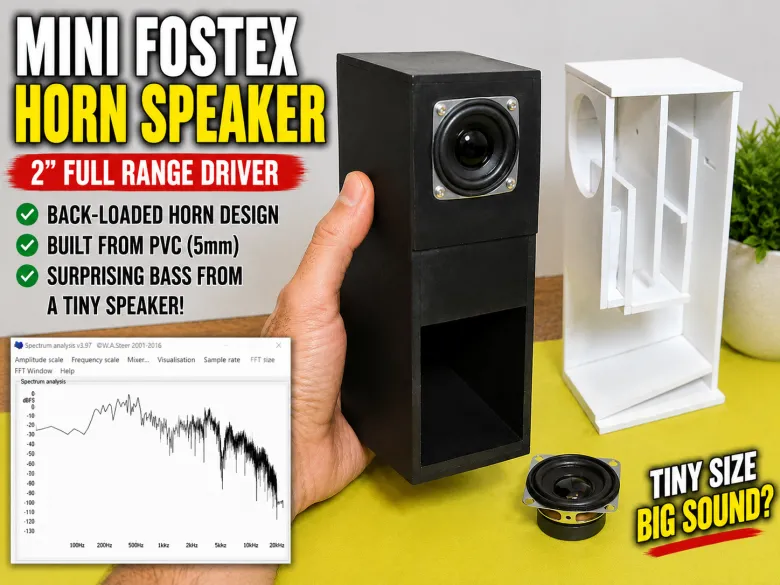
Story
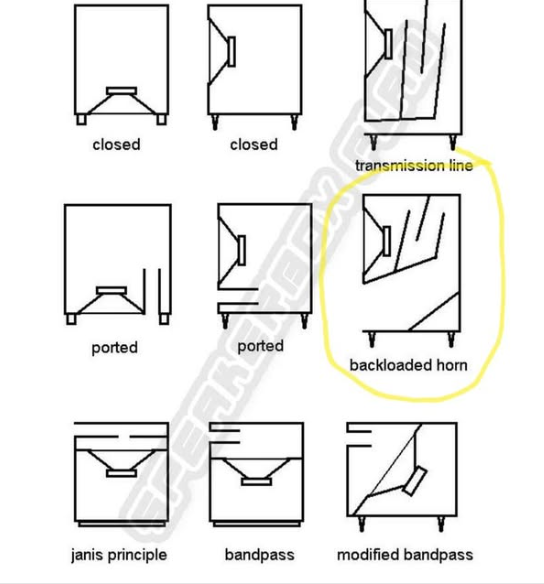
A back-loaded horn speaker is a loudspeaker design that channels the rear sound wave of a driver through a folded horn inside the cabinet to amplify bass efficiently and reduce distortion.
Unlike standard boxes, a back-loaded horn utilizes a complex, winding internal pathway that expands gradually like a musical instrument. The sound waves radiating from the back of the speaker cone travel through expanding channel (the horn), which acoustically amplifies the lower frequencies.
By the time the sound exits the mouth of the horn, it reinforces the bass response, delivering a surprisingly warm, full, and rich sound from a single, full-range driver without the need for a separate subwoofer or crossover network. In this project, we are taking a legendary design concept from Fostex—originally built for massive 8-inch drivers—and scaling it down into a miniature desktop masterpiece. We will be housing a cheap tiny 2-inch full-range driver inside a micro-horn chassis crafted from 5mm PVC material. Driver costs about 2$.
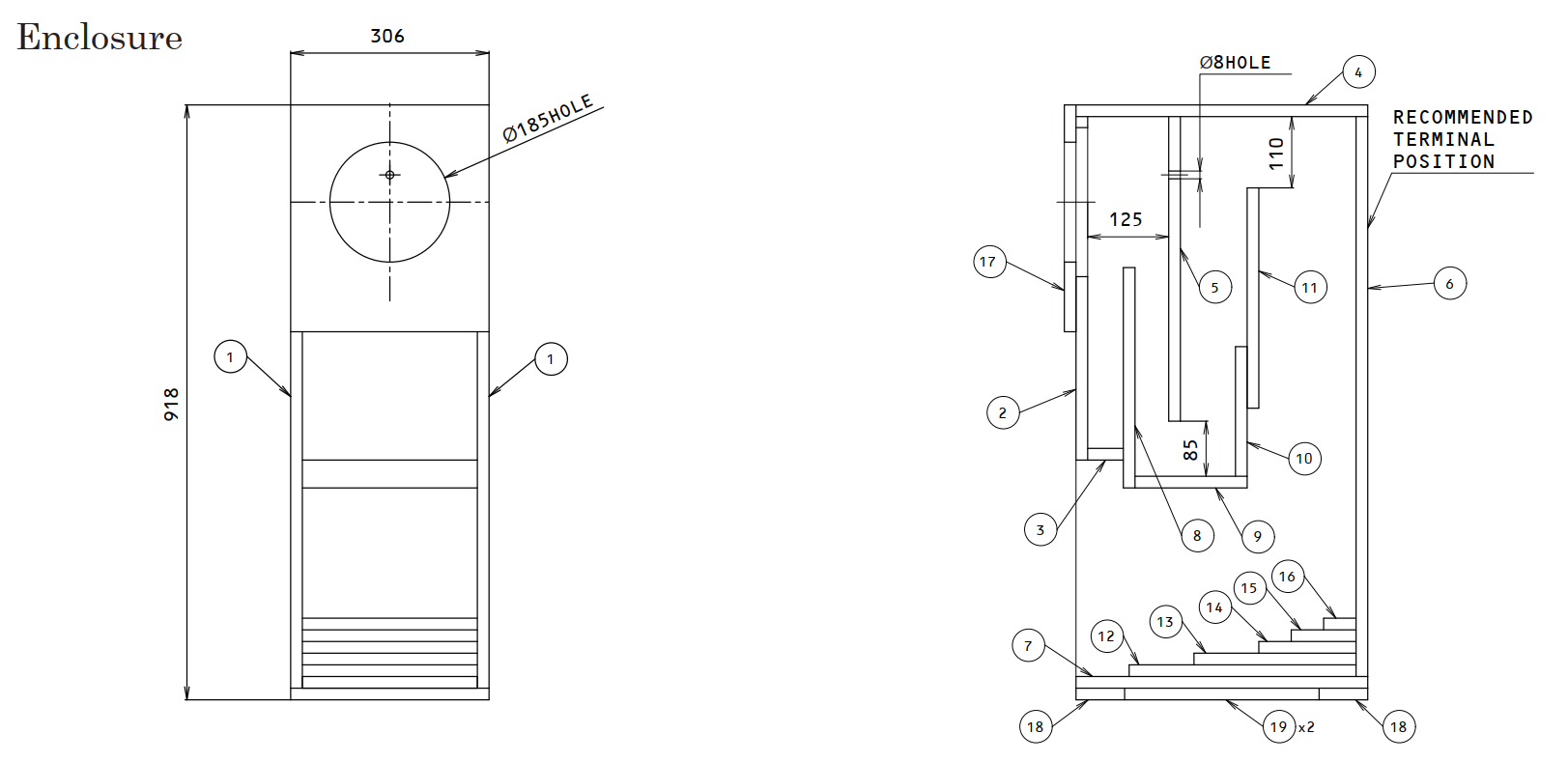
You can download the original drafts at the official Fostex link. And right from the start, I want to emphasize that this is not a true Hi-Fi quality speaker, but simply a small experiment with which I wanted to test the characteristics and efficiency of this type of speaker box. At the very beginning, I studied the method of designing this type of box, which, by the way, despite the many software for that purpose, is still quite complex and requires a lot of work and testing. When designing, it is necessary to know the basic characteristics of the driver, among which the most basic are the Resonant Frequency and Thele Small parameters given by the manufacturer.
Detailed video description at: https://youtu.be/MtZ3xx4ndXs
Of course, there is simply no data for this small, cheap driver. At home, without using expensive instruments, we can measure the resonant frequency with great precision, and that is the basic data for making any type of sound box. We need a computer or phone with an audio frequency generator application, an audio amplifier, a resistor with a value of about 10 to 47 Ohms, and a digital multimeter.
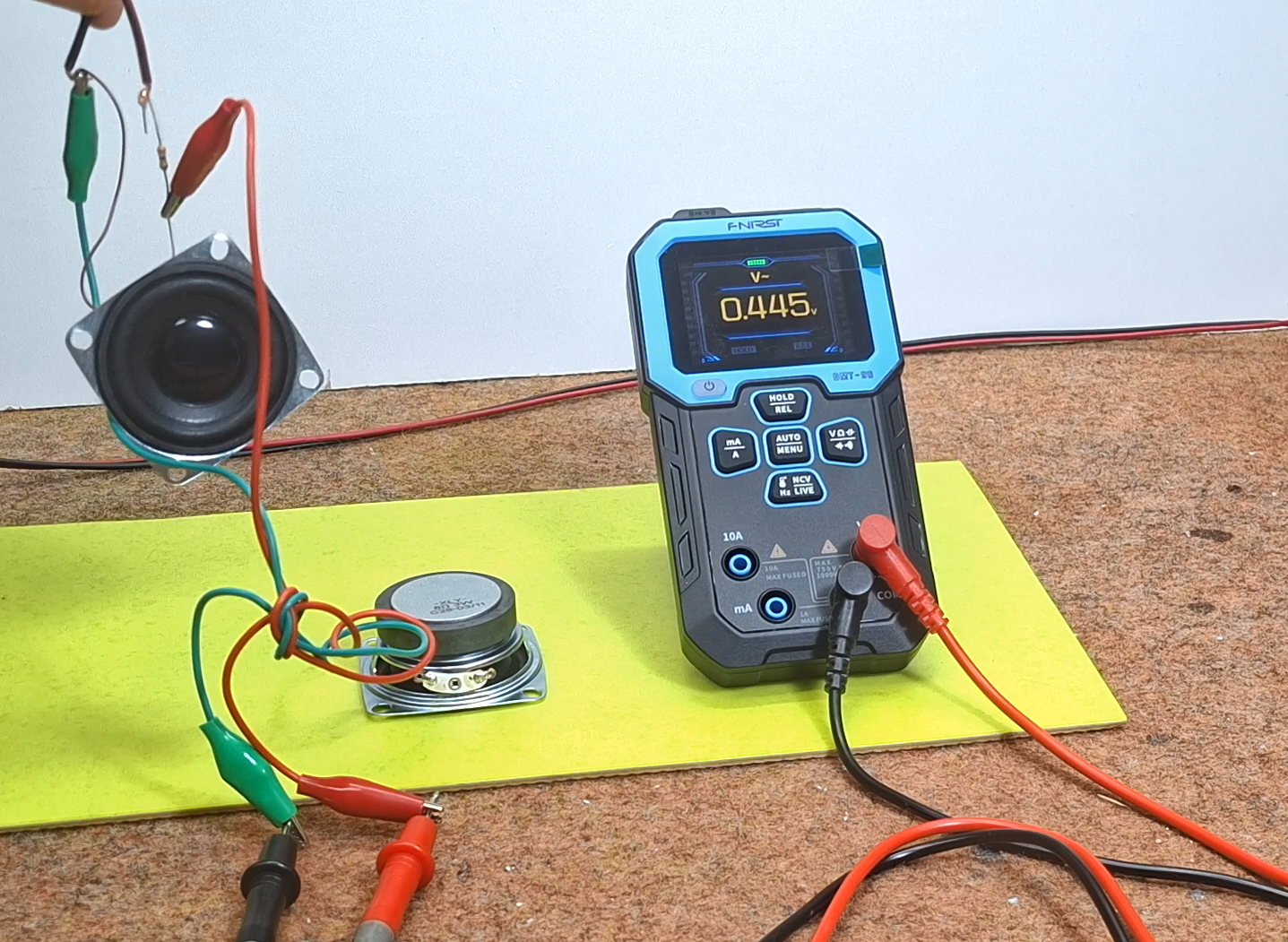
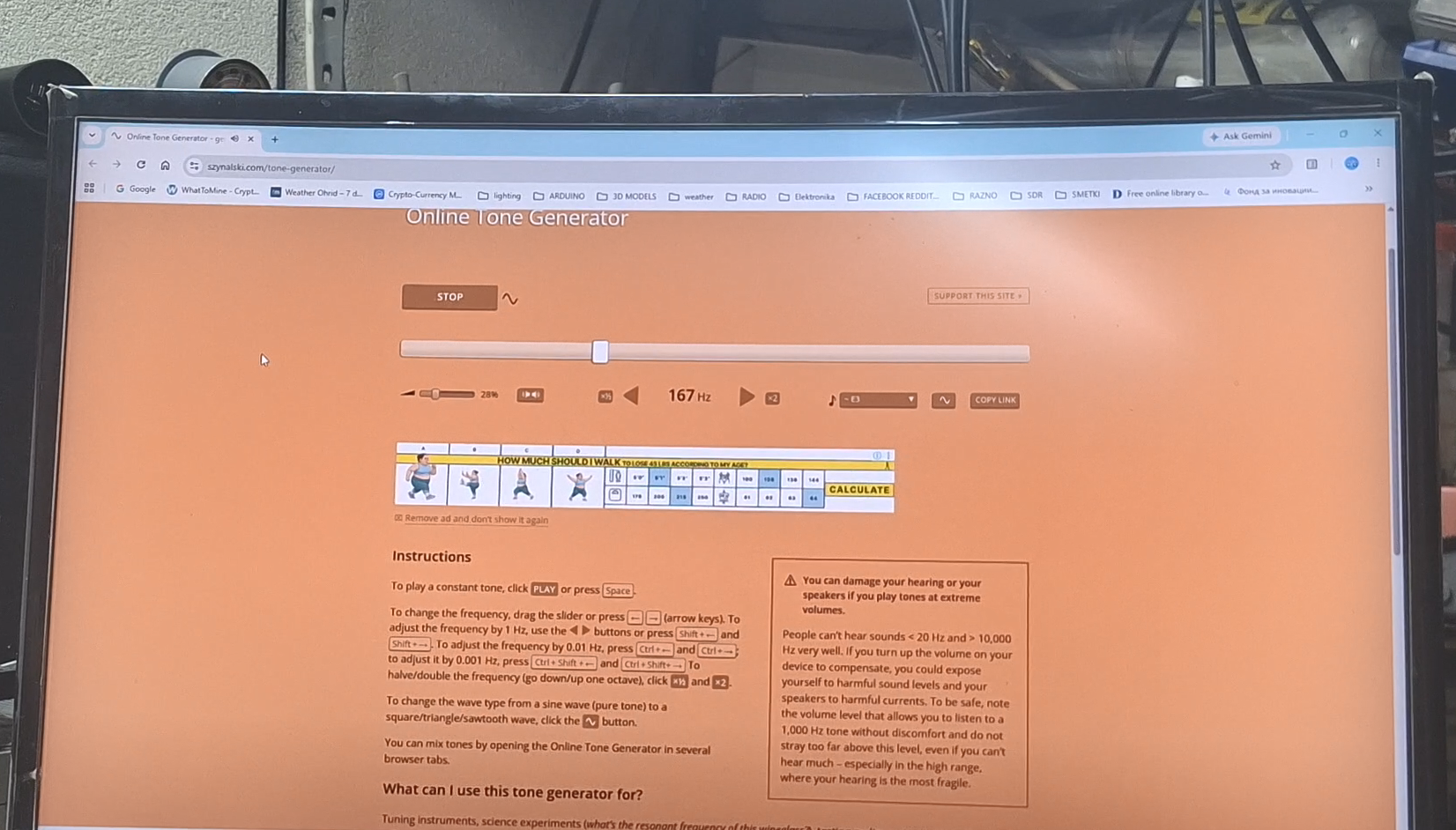
I will use online ton generator. I connect the output of the amplifier through a series resistor to the speaker. Then I connect the multimeter directly to the speaker terminals and let the speaker hang freely in the air so that there is no influence from the environment. Now I gradually change the frequency from 40Hz and up. As the frequency increases, the voltage changes, and when it reaches its maximum value, we read the resonant frequency of the speaker. For this speaker in particular, it is about 170Hz.
This is the sound box in the construction phase where the sound path from the driver to the exit (mouth) can best be seen.
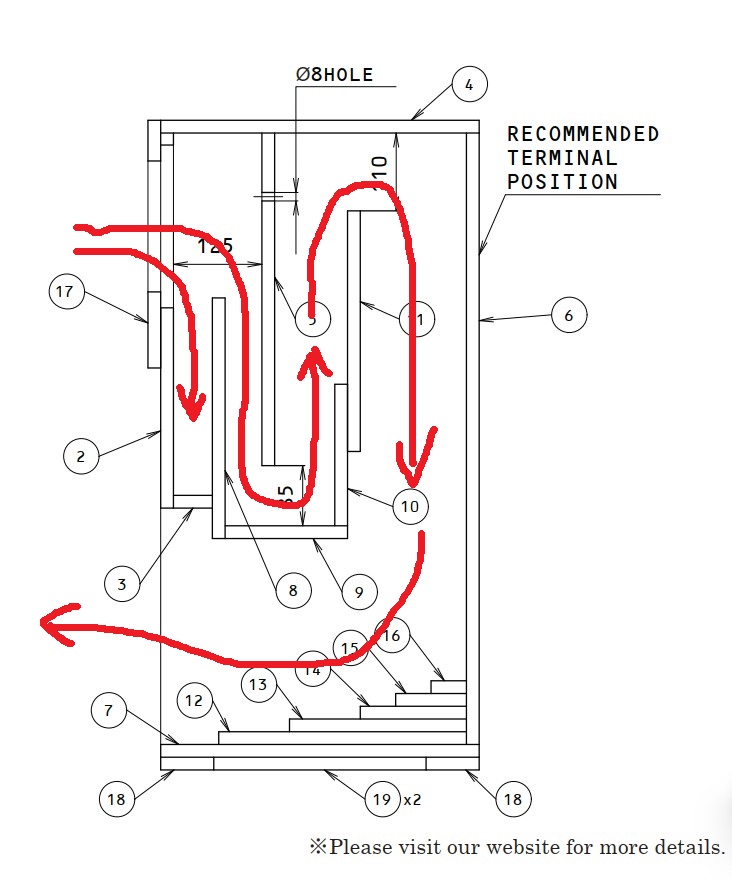
Immediately behind the driver where the sound is generated, there is the first chamber which represents a semi-open sound box in which a damping material is placed. Then the sound continues through a channel which expands exponentially and whose dimensions depend mostly on the resonant frequency of the driver. It should be known that proportional reduction of dimensions does not work like with classic boxes where you can simply reduce the volume proportionally. However, in this specific case, with rough calculations, I came to the result that the resonant frequency of this box is approximately equal to the one I measured for the driver. This was much simpler for me than designing a completely new box with minimally better results.
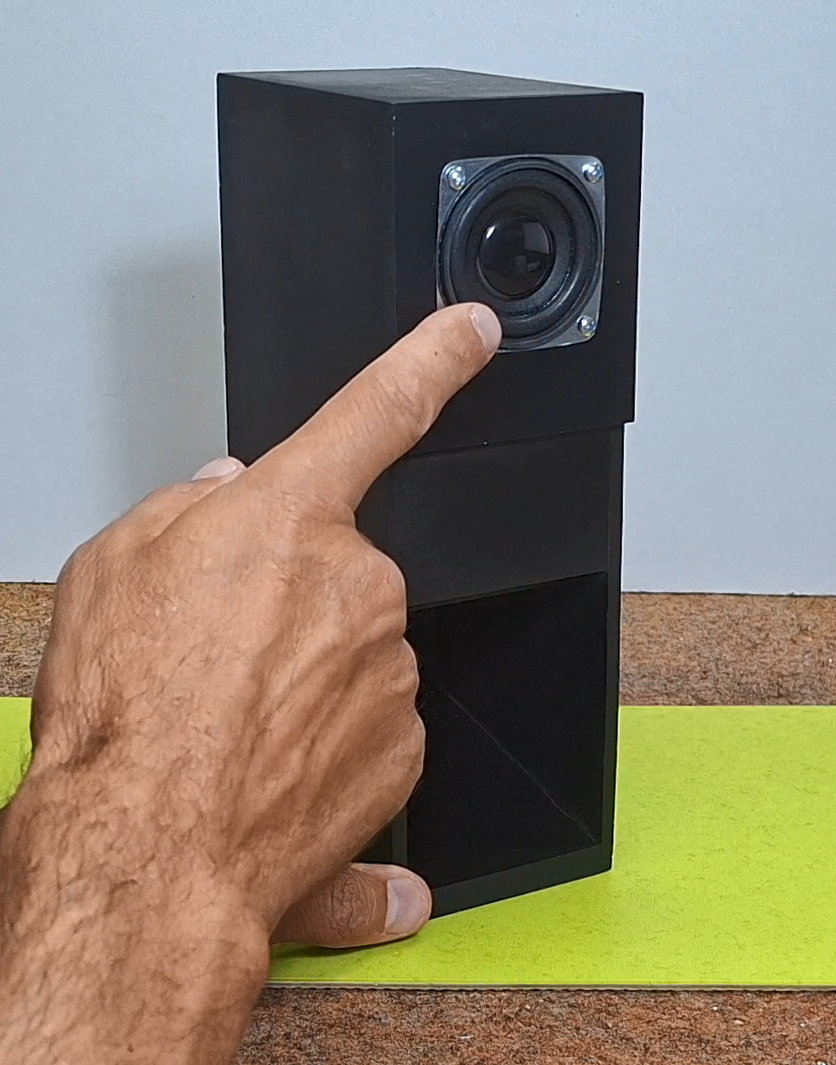
Next comes the most interesting part, which is testing the characteristics of this small speaker. Unfortunately, you will not be able to capture the exact sound through the recorded audio, but I will try to convey it to you, based on my listening tests. For obvious reasons, for testing I will be using songs from the YouTube library. So that you can at least roughly get a feel for what kind of sound it is, along with this speaker, I connected my NAD 801mm to the other channel to make a rough comparison. I put a red LED on both speakers as an indicator of the active speaker at the moment. By changing the balance, I will test the sound of both speakers.
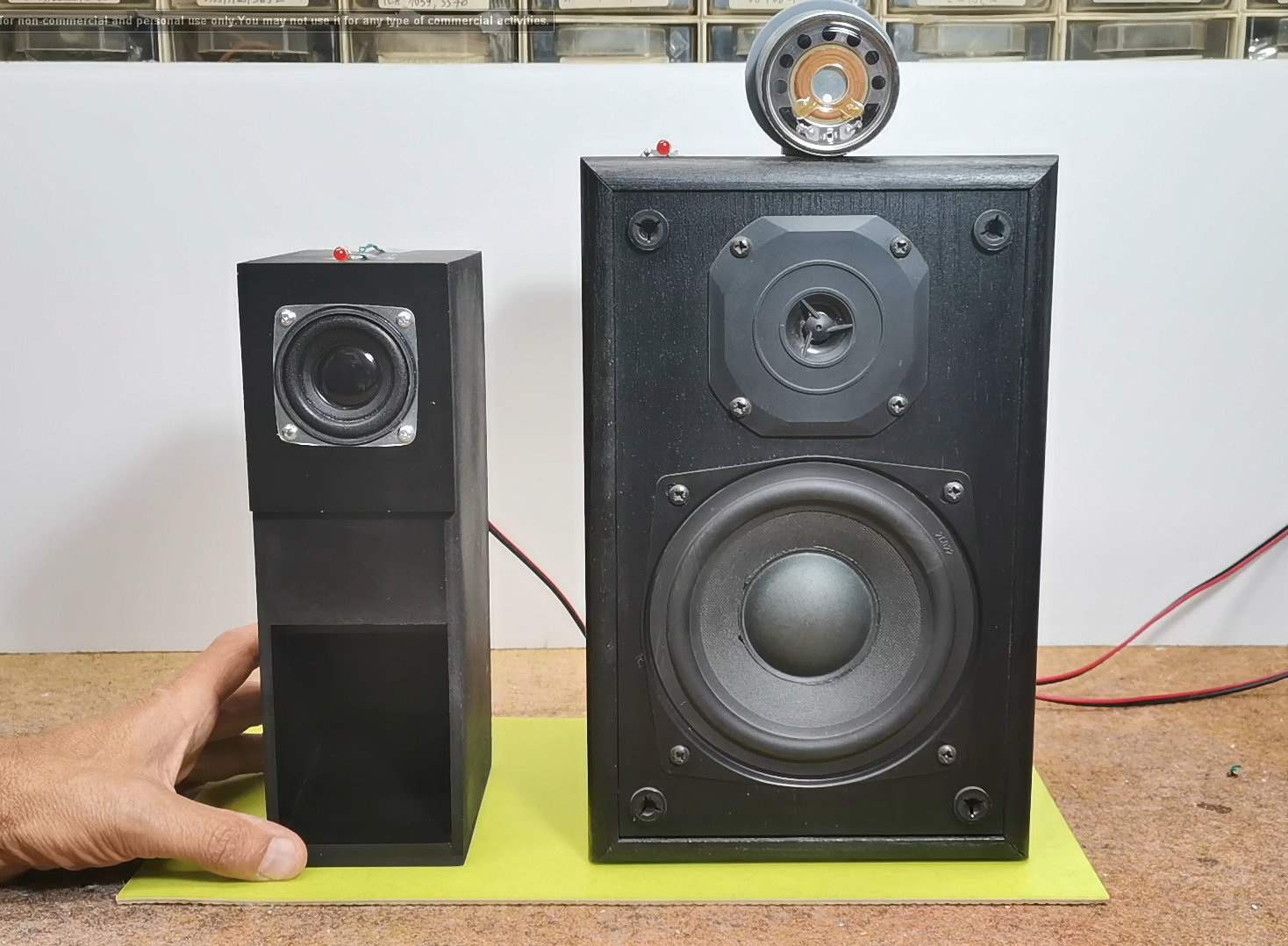
As I said at the beginning, we should not expect some super high-quality hi-fi sound, but still, unlike a regular compression box, we have a noticeable boost somewhere in the higher bass or low midrange (around 150–300 Hz) which results in a slightly "more aggressive" sound in vocals, unlike a closed box which often results in a very thin and quiet sound. Although this box does not produce true sub-bass, it will still produce much more energy and noise in the mid-bass than a miniature closed box. The sound is more vivid, and the box looks like a work of art on the desk.
Now I am going to try to do an extremly rough test to determine the frequency response of the two speakers. Fotr this purpose I am using a online pink noise generator and free spectral analysis software. With small microphone I am going to pick up the sound from two speakers separately. I am practically interested in the low frequency responce because this microphone is relatively insensitive to higher frequencies.
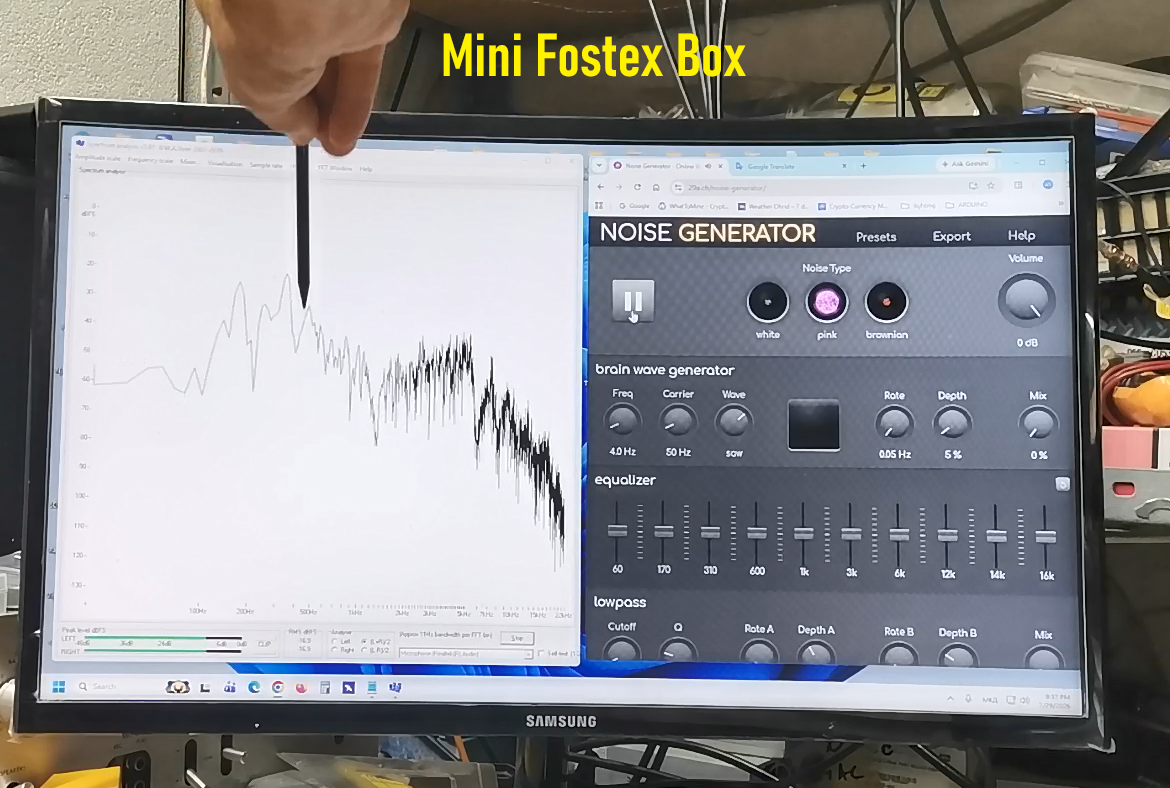
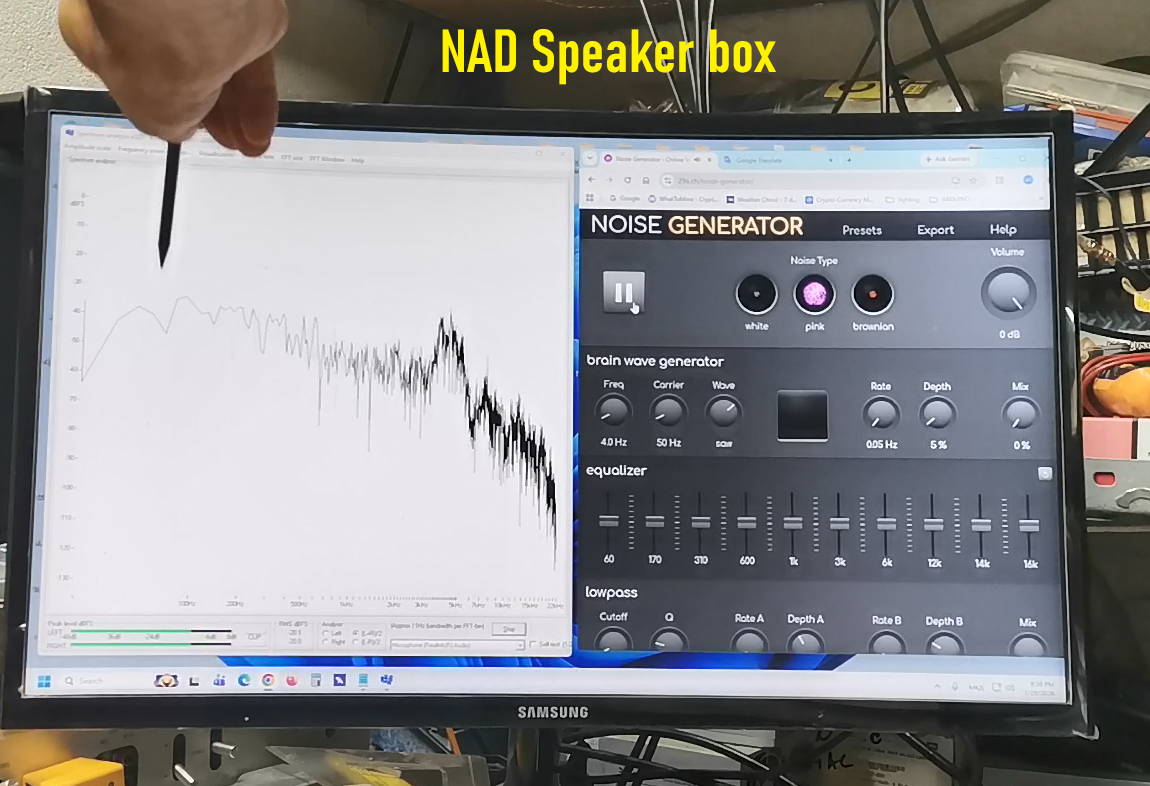
And finally, after a relatively long listening to various musical sounds, I want to give you my real but certainly subjective opinion about this small sound box. The complete sound image is far below my expectations at the beginning of the development of this project. Of course, first of all, the quality, i.e. the extremely low price of the driver, should be taken into account. In general, regardless of the previous remarks, this type of speaker is not practical, or I would say good enough for use as a full range sound box for a very simple reason - and that is the very high resonant frequency of this box-driver system which is around 300Hz and actually represents a low midrange area and there is no defined bass at all. However, the entire midrange range is heard clearly and the low midrange areas are especially strongly expressed. Also, thanks to the small and relatively solid membrane of the driver, the high-frequency spectrum is surprisingly good for such a cheap driver. And it is precisely the features that prevail in this speaker that are missing in the larger NAD 801mm, so their combination complemented each other perfectly, so the overall sound when both speakers were active was far wider, clearer and brighter than on the NAD itself. What surprised me the most was the fact that when listening to purely instrumental tracks, where there is practically no real bass, this small speaker was definitely superior to the Reference NAD 801, both in terms of sound quality and intensity. In the latter case, for the same input power, this small speaker sounds much more powerful and more pronounced than the reference large speaker.
I have currently started making a Bass-reflex, as well as a Compression box with the same small driver, and in one of the next videos I will make a real comparison between the three small speakers with the same driver but a different type of box.