
















Story
PCM58 R2R NOS DAC with 24-bit I2S Input
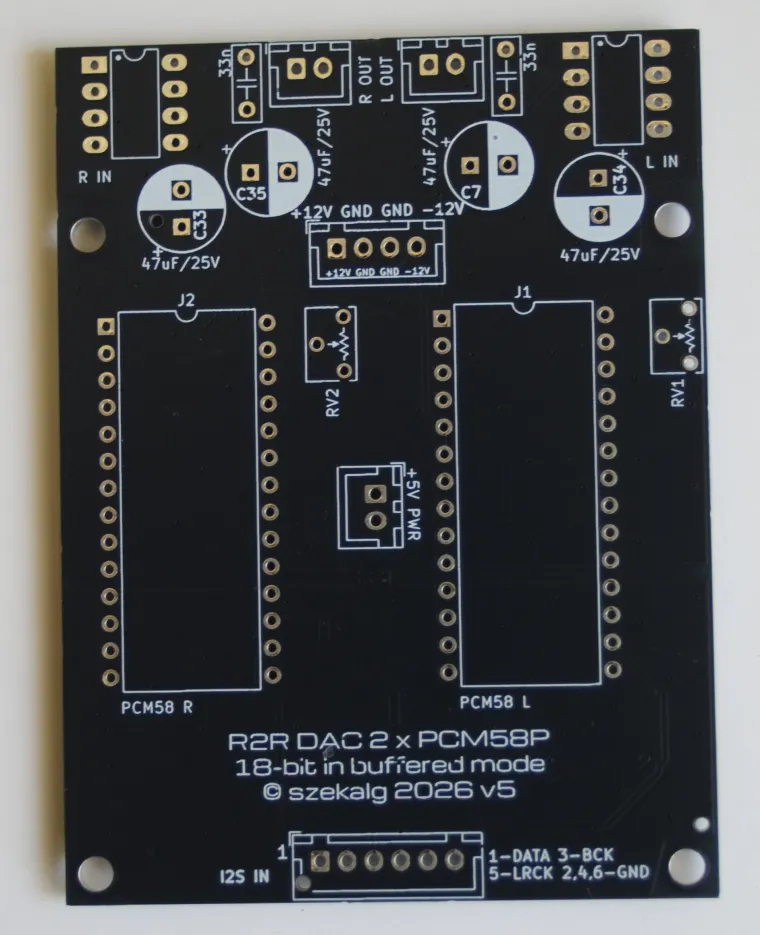
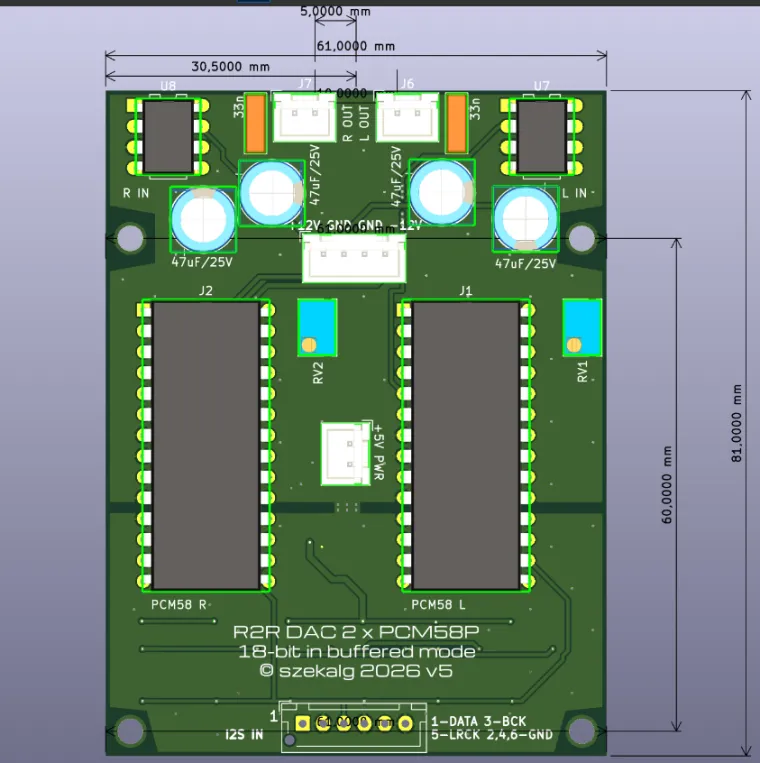
This project is a compact stereo R2R NOS DAC based on two classic Burr-Brown PCM58 18-bit converters, with one DAC chip dedicated to each audio channel.
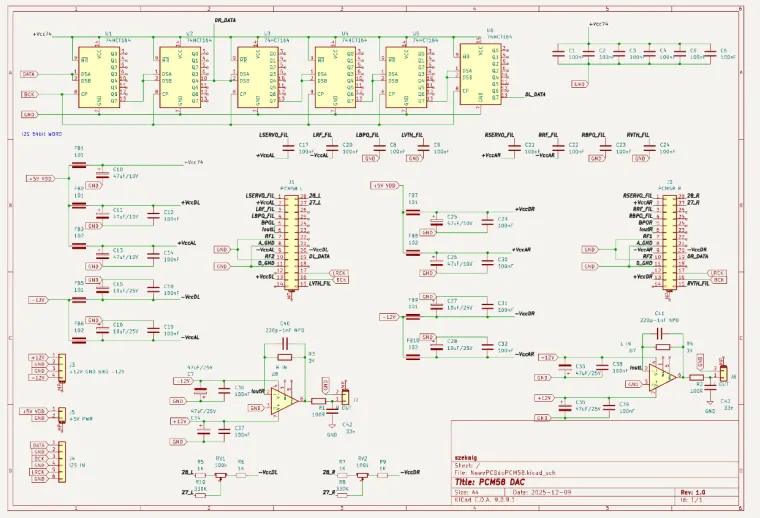
The board accepts a standard 24-bit I2S digital audio stream and converts it into the serial input format required by the PCM58.
The main goal of this project was to create a compact, high-performance and relatively inexpensive true multibit R2R NOS DAC that can also be assembled economically by a PCB fabrication and assembly service.
Main features
- 2 × Burr-Brown PCM58 18-bit monolithic R2R DACs
- One PCM58 converter per audio channel
- True NOS – Non-Oversampling operation
- 24-bit I2S digital input
- I2S conversion to the serial format required by PCM58
- Buffered digital signal path
- Separate analog and digital ground sections
- Improved local power-supply filtering
- Individual PCM58 distortion adjustment
- Socketed PCM58 DAC chips
- Socketed DIP8 I/V operational amplifiers
- Optional analog high-frequency output filter
- Compact PCB optimized for economical PCBA production
PCB and assembly
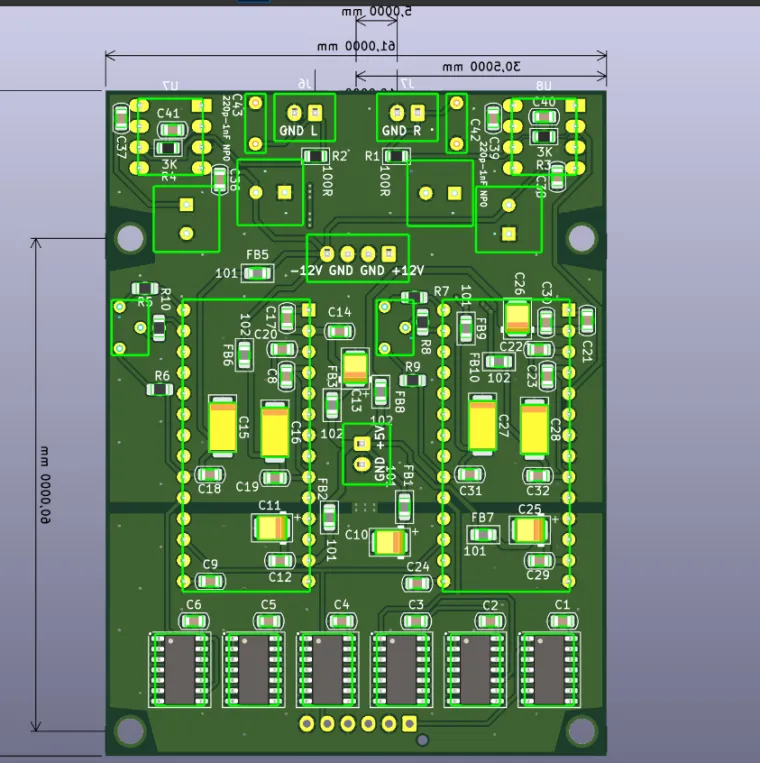
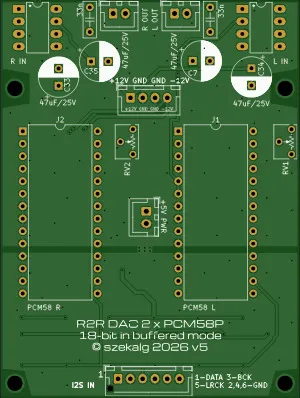
The PCB was designed primarily for SMD assembly. All SMD components are located on one side of the PCB.
This was an intentional design decision. Single-sided SMD assembly simplifies automated production and helps reduce the cost of PCBA manufacturing at the fabrication house.
Only a small number of through-hole components have to be installed manually:
- 4 × electrolytic capacitors
- 2 × DIP8 sockets for the I/V operational amplifiers
- 2 × wide DIP28 sockets for the PCM58 converters
- 2 × 100 kΩ Bourns 3266W vertical trimmer potentiometers
- optional 33 nF output filter capacitors
The PCM58 chips therefore do not have to pass through the automated assembly process. They can simply be inserted into the wide DIP28 sockets after the assembled PCB is received from the fabrication house.
The same applies to the DIP8 operational amplifiers, making it very easy to test different op-amps or replace them later.
Why PCM58?
The Burr-Brown PCM58 is a classic 18-bit monolithic precision multibit R2R DAC designed specifically for high-quality digital audio applications.
Unlike many modern discrete R2R DAC implementations, where the conversion ladder is constructed from a large number of external precision resistors, the critical conversion structure of the PCM58 is integrated inside a monolithic semiconductor device.
This type of precision integrated multibit DAC technology provides extremely good matching of the internal conversion elements and factory trimming. Achieving comparable resistor-ratio accuracy with a discrete external resistor ladder can require very high precision components, careful matching and additional calibration.
This is one of the reasons why the PCM58 can still achieve excellent linearity and very low distortion despite being a DAC designed many years ago.
The PCM58P-K version was specified for extremely low THD+N even without external adjustment, while additional converter trimming can be used to optimize the performance further.
For this reason, a properly implemented PCM58 DAC can still compete very well with many modern discrete R2R designs.
At the same time, the PCM58 can provide a relatively inexpensive way to build a high-quality true R2R NOS DAC.
PCM58 availability
Although the PCM58 has been obsolete for many years, the chips are still available on the secondary market and can still be found from sellers on AliExpress.
Many available PCM58 devices are recovered parts removed from vintage CD players and other older digital audio equipment in which these converters were originally installed.
This makes the PCM58 especially interesting for DIY audio projects because it is still possible to obtain a genuine high-performance monolithic R2R converter without buying an expensive modern discrete resistor-ladder DAC.
When purchasing recovered PCM58 chips, it is recommended to use a reliable seller and test the devices because their history, grading and condition may vary.
Analog output stage
Each PCM58 has its own active I/V conversion stage using a single operational amplifier in a DIP8 package.
Texas Instruments TL071C works very well in this circuit.
The TL071C is a J-FET input operational amplifier with low input capacitance, which is an important advantage when it is used in the I/V stage of a current-output DAC such as the PCM58.
It is also inexpensive and widely available, making it a very practical choice for this project.
Because the operational amplifiers are installed in DIP8 sockets, other compatible single operational amplifiers can also be tested very easily.
Optional analog output filter
The PCB includes positions for optional 33 nF through-hole capacitors located near the analog outputs.
These capacitors form a simple high-frequency output filter.
The 33 nF capacitors are optional and do not have to be installed.
Leaving them unpopulated allows the DAC to operate without this additional analog filtering, while installing them provides simple attenuation of high-frequency components present at the output of a NOS DAC.
This makes it easy to experiment with both approaches without modifying the PCB.
PCM58 distortion adjustment
The PCB includes an individual 100 kΩ Bourns 3266W vertical trimmer potentiometer for each PCM58 channel.
This allows the two DAC converters to be adjusted independently in order to minimize distortion.
An important practical detail is that a detailed adjustment procedure using an external 100 kΩ potentiometer is described in the PCM56 datasheet, rather than being explained in the same detail in the PCM58 datasheet.
The PCM56 documentation describes both static and dynamic adjustment methods.
The dynamic method is particularly useful for audio applications. A low-level sine-wave signal is applied and the 100 kΩ trimmer is adjusted while measuring THD until the minimum distortion is obtained.
This provides a practical method for individually optimizing PCM58 converters, including recovered or second-hand devices.
24-bit I2S digital input
The board receives a standard 24-bit I2S audio stream.
Digital logic buffers the incoming I2S signals and converts the data into the serial format required by the PCM58 converters.
The I2S input format is 24-bit, while the PCM58 itself is an 18-bit converter. The digital logic handles the required conversion and delivers the appropriate data to each PCM58 channel.
The digital section distributes the data to the left and right DAC channels while keeping the logic circuitry compact and separated from the sensitive analog section.
USB to I2S connection
By adding a commonly available USB to I2S interface, the board can be used as a complete USB R2R NOS DAC.
This makes it possible to connect the DAC to many commonly used digital audio sources, including:
- audio streamers with USB Audio output
- Raspberry Pi and other single-board computers
- desktop PCs
- laptops
- smartphones
- tablets
A Raspberry Pi can therefore be used as a compact network streamer, while a smartphone or tablet can be used as a portable digital audio source.
For smartphones and tablets, a suitable USB OTG or USB-C connection may be required depending on the device.
This allows the PCM58 board to be combined with many inexpensive and widely available USB-to-I2S modules.
The DAC can also be used with other digital interfaces, for example:
- S/PDIF COAX to I2S converters
- TOSLINK to I2S converters
- audio streamers with compatible native I2S output
- other digital audio sources providing a compatible 24-bit I2S signal
This makes the board flexible enough to be used both as a standalone DIY DAC and as the R2R conversion stage of a larger digital audio system.
Power supply
The board requires three supply rails:
- +5 V for the digital section
- +12 V for the analog section
- -12 V for the analog section
Good power-supply quality is recommended, especially for the analog section and the I/V converters.
What is needed to complete the DAC
- 2 × PCM58 DAC chips
- 2 × DIP8 single operational amplifiers, for example TI TL071C
- +5 V and ±12 V power supplies
- compatible I2S digital audio source
- or a USB to I2S interface for USB Audio sources
- analog output connectors
- enclosure and basic wiring
The result is a relatively simple and affordable way to build a true 18-bit monolithic R2R NOS DAC using one of Burr-Brown's classic precision audio converters.
The project can be combined with inexpensive modern USB-to-I2S, S/PDIF-to-I2S or TOSLINK-to-I2S interfaces while keeping the actual digital-to-analog conversion in the classic PCM58 multibit R2R domain.
For DIY audio enthusiasts, the board also provides an interesting platform for experimenting with NOS playback, different I/V operational amplifiers, individual PCM58 trimming and optional analog output filtering.