








Story
# Arduino Uno SMD with Integrated MPU-6050 + BMP280
## Project Overview
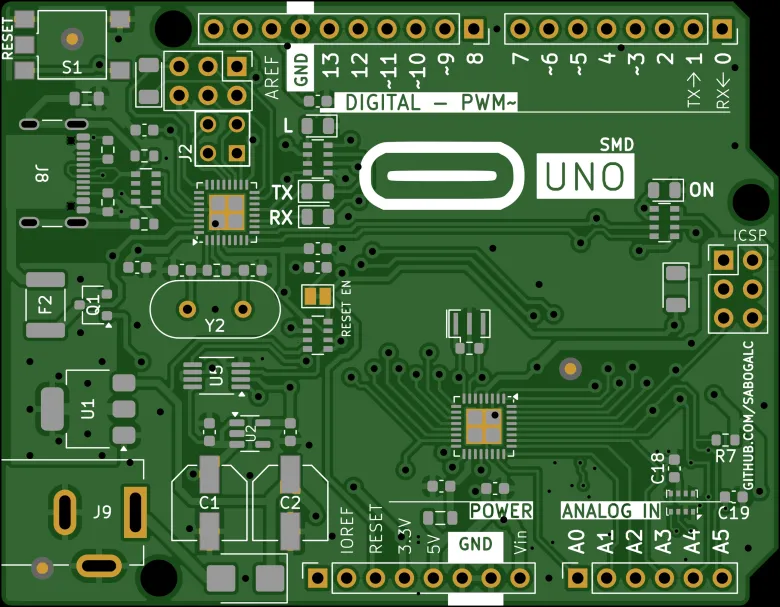
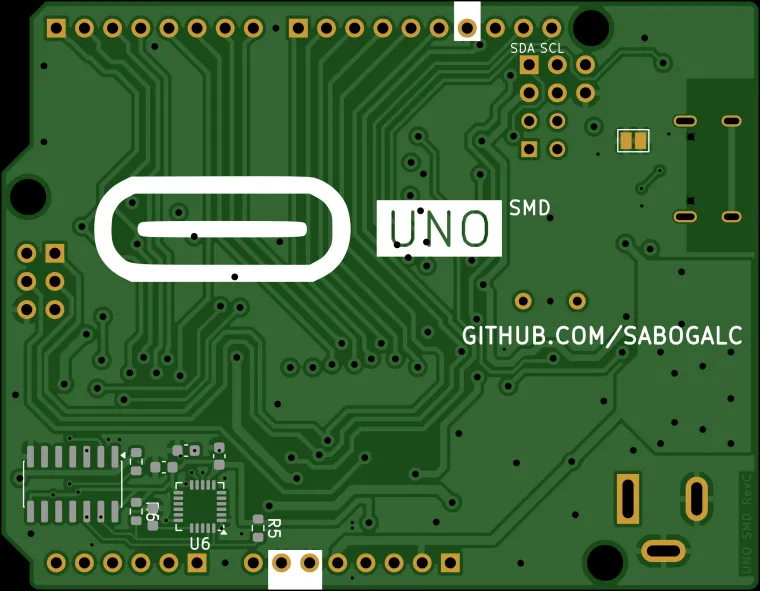
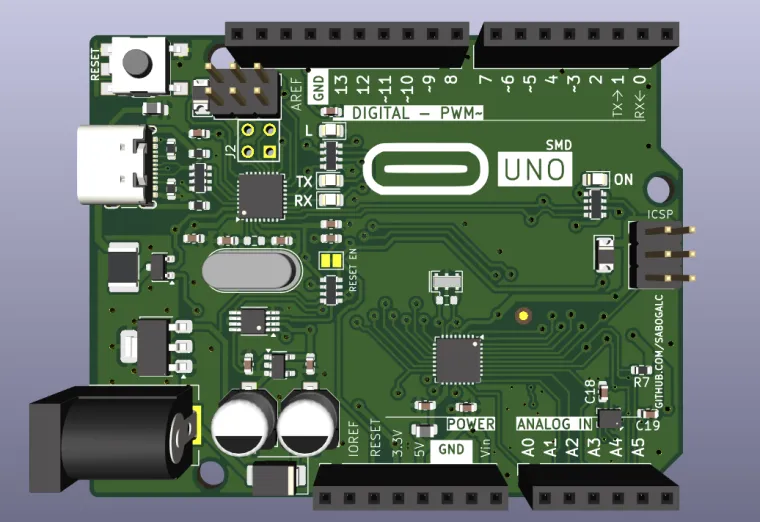
This project is an enhanced Arduino Uno-compatible development board based on the Arduino Uno SMD design.
The main idea is to integrate useful sensors directly onto the Arduino PCB instead of requiring separate breakout boards, additional wiring, and mechanical mounting.
This version integrates two sensors directly onto the board:
* **MPU-6050 6-axis IMU**
* **Bosch BMP280 barometric pressure and temperature sensor**
Both sensors are connected internally through the I²C interface, with the required voltage-level translation and supporting circuitry integrated into the PCB.
The result is a compact Arduino Uno-compatible board that combines the normal Uno functionality with onboard motion, pressure, temperature, and altitude-sensing capabilities.
---
## Why This Project Exists
Adding sensors to an Arduino project normally requires additional breakout boards.
For a project using an IMU and barometric sensor, this can result in:
* Multiple PCBs
* Additional jumper wires
* More connectors
* Extra mechanical mounting
* Increased space requirements
* Less consistent sensor positioning
This becomes particularly inconvenient in compact robotics and embedded projects.
By placing the sensors directly onto the Arduino PCB, the sensor positions are fixed relative to the controller.
This reduces wiring and mechanical complexity while providing a repeatable physical arrangement between the sensors and the rest of the electronics.
---
# Integrated MPU-6050 IMU
The board contains an onboard **MPU-6050**.
The MPU-6050 provides:
* 3-axis accelerometer
* 3-axis gyroscope
* Motion sensing
* I²C communication
The sensor is mounted directly on the PCB rather than on a separate breakout board.
This makes the board useful for applications involving motion measurement, robotics, orientation experiments, acceleration measurements, and sensor-fusion projects.
The MPU-6050 is connected to the Arduino's I²C interface through the onboard voltage-level translation circuitry.
---
# Integrated BMP280
The second integrated sensor is the **Bosch BMP280**.
The BMP280 provides:
* Atmospheric pressure measurement
* Temperature measurement
* Pressure-based altitude estimation
* I²C communication
Integrating the BMP280 directly onto the PCB allows pressure and temperature measurements to be performed without adding another external sensor board.
Combined with the MPU-6050, the board can be used for experiments involving both motion and environmental measurements.
---
# Dual-Sensor I²C Architecture
Both sensors communicate using I²C.
The Arduino operates in its normal 5 V environment, while the integrated sensors use their appropriate lower-voltage supply and logic levels.
To handle this, the PCB incorporates a **TXS0104ED bidirectional voltage-level translator**.
The board also includes the required I²C pull-up resistors and supporting circuitry.
This means that the voltage-level conversion is handled internally.
The user does not need to add a separate external level-shifter board just to connect the integrated sensors to the Arduino.
---
# Arduino Uno-Compatible Core
The board retains the core architecture of an Arduino Uno.
The main controller is:
**ATmega328P-MU**
The USB interface is handled by:
**ATmega16U2-MU**
This keeps the familiar Arduino Uno architecture while adding additional onboard hardware.
The standard Arduino-style expansion headers remain available, so external sensors, displays, motor controllers, and other peripherals can still be connected.
The integrated sensors therefore supplement the Uno rather than replacing its normal expansion capabilities.
---
# USB Type-C
The board uses a **USB Type-C connector**.
The USB interface retains the functionality provided by the ATmega16U2 while using a modern USB-C physical connector.
This makes the board more convenient to connect to modern computers and USB-C cables.
---
# Power Architecture
The board includes both 5 V and 3.3 V power circuitry.
The design includes:
* 5 V regulation
* 3.3 V regulation
* USB power input
* Barrel-jack power input
* Power protection
* Polyfuse protection
* Reverse-polarity protection
* Ferrite filtering
* Local decoupling
The 3.3 V rail is used for the integrated sensor circuitry.
This keeps the sensor power requirements internal to the board.
---
# Additional Hardware
Along with the two integrated sensors, the board includes the supporting hardware required to operate as a complete Arduino-compatible development board.
The design includes:
* ATmega328P-MU
* ATmega16U2-MU
* USB Type-C
* Arduino-compatible headers
* Barrel-jack power input
* Reset switch
* Status LEDs
* 5 V regulator
* 3.3 V regulator
* TXS0104ED level translator
* MPU-6050
* BMP280
* I²C pull-up resistors
* Power protection
* Decoupling capacitors
* Filtering components
---
# Mechanical Advantages
One of the main goals of the project is to reduce the mechanical complexity associated with using sensor breakout boards.
With conventional breakout boards, the sensors have to be mounted somewhere around the Arduino.
That can create problems in compact designs where every millimeter of PCB and mechanical space matters.
Here, the sensors are already part of the Arduino PCB.
Their location and orientation relative to the main controller remain fixed from board to board.
This can be useful when developing robotics platforms where the sensor coordinate system needs to have a consistent relationship with the rest of the robot.
---
# Robotics Applications
The combination of an onboard IMU and barometric sensor makes the board particularly suitable for robotics and embedded experiments.
Possible applications include:
* Robotics
* Motion sensing
* Self-balancing systems
* Altitude experiments
* Environmental monitoring
* Autonomous systems
* Sensor fusion
* Motion logging
* Physics experiments
* Educational projects
* Compact embedded systems
* Arduino-based research and prototyping
For example, the MPU-6050 can provide acceleration and gyroscope data while the BMP280 provides pressure and temperature measurements.
Both can be processed by the ATmega328P.
---
# Fabrication-Ready Design
The project includes the files required to reproduce the board rather than being only a conceptual design.
The repository contains:
* KiCad schematic
* KiCad PCB layout
* Component footprints
* BOM
* Component designators
* Component placement data
* IPC netlist
* Production files
* Gerber/fabrication package
* 3D/STEP-related files
* PCB models and renders
The production directory also contains a packaged fabrication output together with the BOM, placement data, designators, and IPC netlist.
This makes the project suitable for PCB fabrication and assembly.
---
# Open Hardware Development
This project is part of an ongoing collection of modified Arduino-compatible hardware designs.
The objective is to take familiar development-board architectures and integrate useful functionality directly onto the PCB.
Instead of building a project from an Arduino plus several separate breakout boards, the goal is to create a single board that already contains commonly required hardware.
The design files are publicly available so that other makers, students, robotics enthusiasts, and electronics developers can inspect, modify, and manufacture the design.
---
# Possible Future Development
This project can serve as a foundation for future Arduino-compatible boards with additional integrated peripherals.
Possible future additions include:
* Additional environmental sensors
* Displays
* Data logging
* Wireless connectivity
* Additional robotics interfaces
* More onboard measurement capabilities
The overall concept is to progressively turn the familiar Arduino Uno form factor into a more capable integrated development platform while maintaining its basic compatibility and expansion interface.
---
# Credits
The underlying Arduino Uno SMD KiCad design was based on the work of **sabogalc**.
This project modifies and extends that design by integrating the MPU-6050, BMP280, voltage-level translation, associated power circuitry, and manufacturing data.
---
# Project Repository
The complete project is available here:
**GitHub:**
https://github.com/kaustubh850/ArduinoEquipped
**Project:**
`Arduino Uno IMU+BMP280`
The repository contains the design and manufacturing files needed to inspect, modify, and reproduce the board.
---
# Project Goal
The goal of this project is to make an Arduino Uno more capable without requiring the user to build an entire collection of external sensor modules around it.
By integrating the **MPU-6050 and BMP280 directly onto the Arduino PCB**, the board combines:
**Arduino control + motion sensing + pressure sensing + temperature sensing**
into a single compact development board while retaining the familiar Arduino Uno expansion interface.